
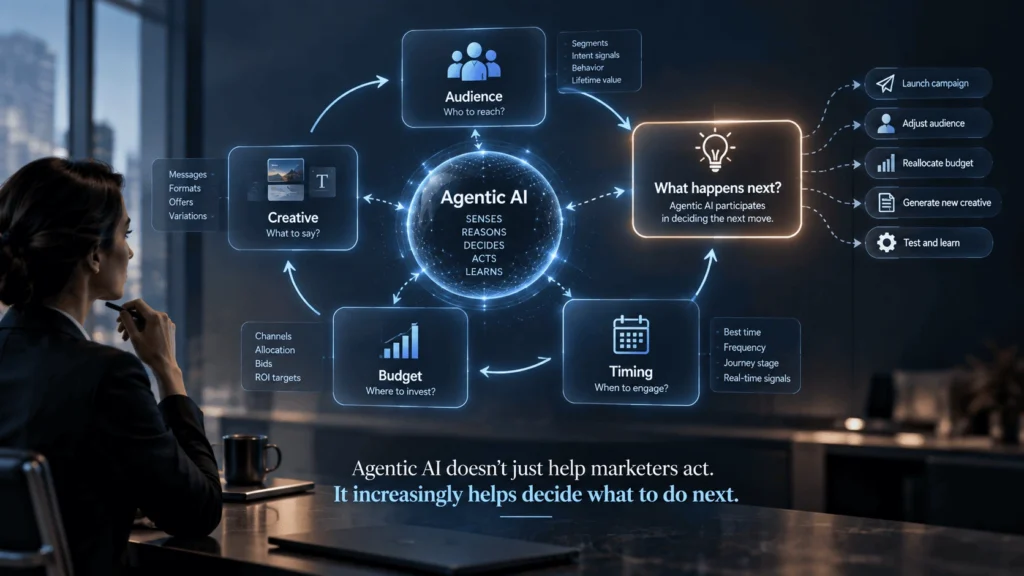
A campaign manager used to sit in the middle of a familiar loop: choose the audience, pick the creative, decide when to launch, watch the results, and adjust the budget. Every step ran through a person, even when the data did most of the work.
That loop is starting to run itself – not the strategy, but the mechanics. A growing class of AI systems can watch a campaign’s performance, decide what to change, act through connected tools, then judge whether it worked.
That’s Agentic AI, a different kind of shift than the content-generation wave before it. Generative AI changed what marketing teams could produce. Agentic AI is starting to change who – or what – decides what happens next. This guide covers what that means, where it already works, and where leaders should hold the line.
Agentic AI – What Happens Next?
What Is Agentic AI in Marketing?
Agentic AI in marketing is a goal-driven AI system that can understand marketing context, reason about objectives and constraints, plan multi-step actions, use connected tools and enterprise systems, execute decisions, observe outcomes, and adapt its next actions – within defined boundaries and human oversight.
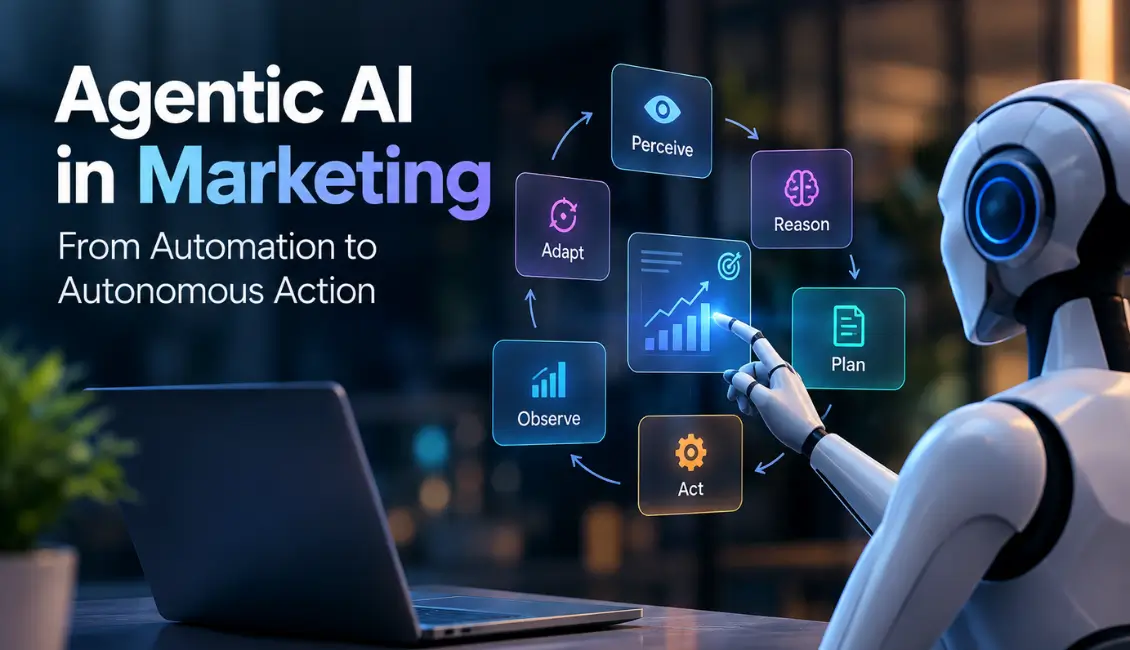
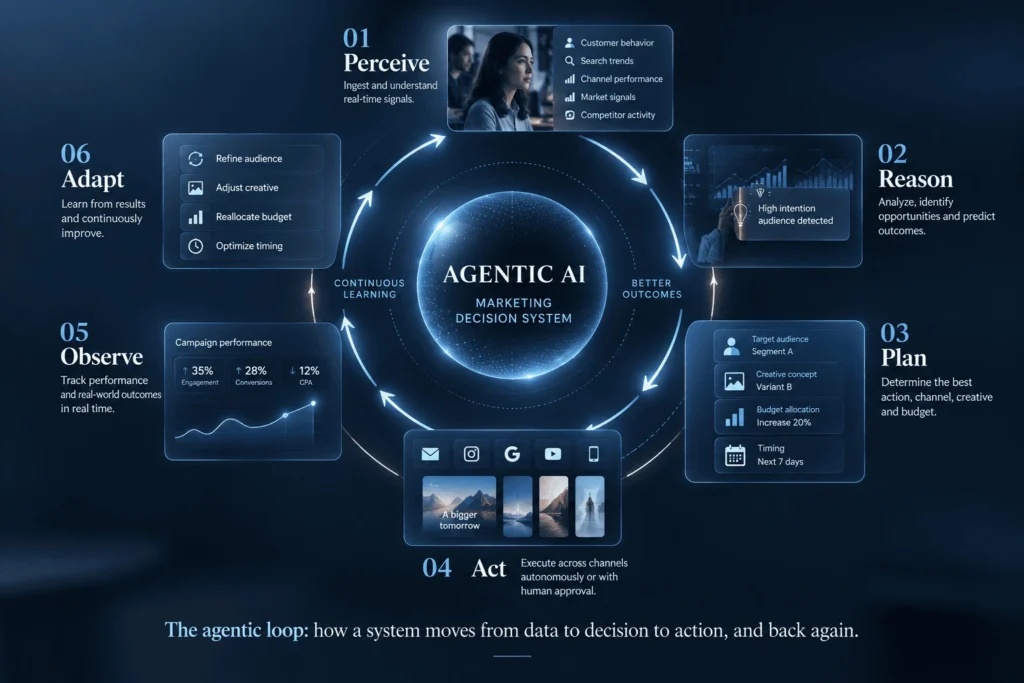
In plainer terms, it follows a loop: Perceive → Reason → Plan → Act → Observe → Adapt. It doesn’t just generate a draft and hand it back. It works toward an objective across several steps, checks what happened, and adjusts.
That’s a meaningfully different job than either of the tools marketers already know.
| Traditional Automation |
Generative AI | Agentic AI | |
|---|---|---|---|
| Role | Executes fixed rules | Produces content on request | Works toward a goal |
| Decision-making | Set by a human in advance | Human decides, AI drafts | AI proposes or executes within limits |
| Workflow | Fixed, rule-based | Single request, single response | Multi-step, ongoing |
| Adaptability | Breaks when conditions change | None between prompts | Adjusts based on feedback |
| Human involvement | Set the rules once | Approve every output | Set goals and guardrails, review outcomes |
Not every workflow using a large language model qualifies as agentic. What matters is whether the system has a goal, plans its own steps, calls real tools, acts on outcomes, and holds some delegated authority. A chatbot that answers questions is not an agent. A system that reallocates ad spend against a target within a budget you set is closer to one.
How Does Agentic AI Actually Work?
Take a campaign agent given one objective: increase qualified leads from enterprise accounts while staying within budget and brand guidelines.
It might work through the loop like this:
- Perceive – pull in campaign, CRM, and audience data.
- Reason – assess what’s driving or holding back lead quality.
- Plan – decide which levers to pull: budget shifts, audience changes, creative swaps.
- Act – execute through connected ad platforms and CRM tools.
- Observe – track what actually happened to lead volume and quality.
- Adapt – refine the next round of actions based on results.
Agentic Loop
What makes this workable isn’t the AI model – it’s the scaffolding around it: Goal, Context, Tools, Authority, Guardrails, Evaluation. Skip one and you get a system that acts confidently on incomplete information – a bigger risk than a system that does nothing.
Where Is Agentic AI Being Used in Marketing?
| Area | What an agent can do |
|---|---|
| Customer intelligence | Score and segment accounts from behavioral and CRM signals |
| Paid media | Reallocate budget and bids toward a performance target |
| Personalization | Choose the next-best content or offer per visitor |
| CRM | Prioritize leads and trigger follow-up sequences |
| Customer experience | Resolve multi-step service requests across channels |
| SEO / AI discovery | Monitor how brand information appears in AI answers |
A few grounded examples:
A. Campaign optimization agent (possible today). Given a ROAS target and a spend ceiling, the agent shifts budget across channels in real time and flags anything outside its authority for a human to approve.
B. Customer experience agent (possible today). The agent handles a delivery issue end-to-end — checking order status, offering a resolution, processing a replacement — and only escalates refunds above a set threshold.
C. AI shopping agent (emerging). A buyer’s own AI assistant compares products across sites using early commerce protocols now rolling out across major platforms and payment networks, then completes part of a purchase within spending limits the buyer set. It’s real, but still early and uneven.
The Biggest Shift: AI Is Becoming a Decision-Maker
The progression matters: AI assistant → AI executor → AI decision-maker → multi-agent system. Each step hands over a little more of the decision, not just the labor.
This is why discussions at an Agentic AI Conference 2026 go beyond content generation to explore how much decision-making authority AI systems should hold, how businesses can govern autonomous actions, and where human oversight remains essential.
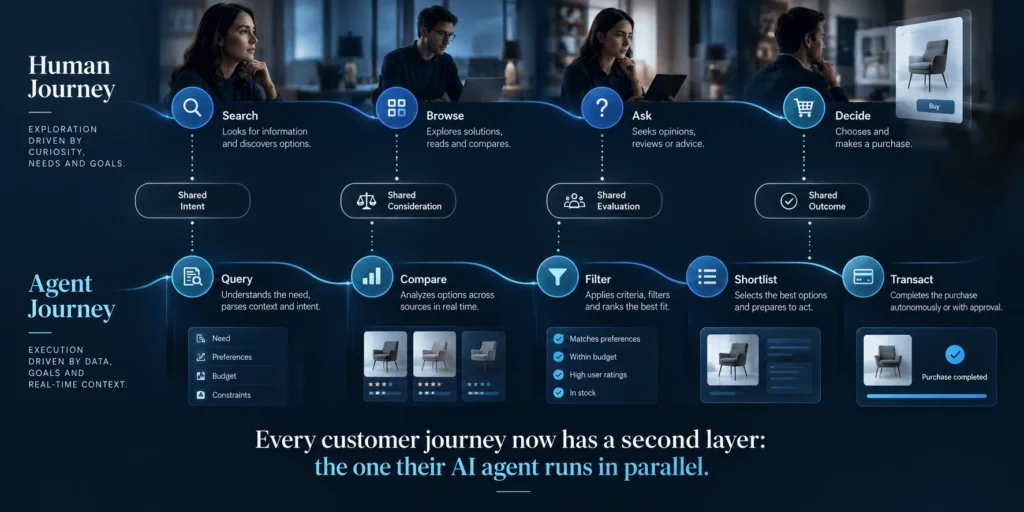
The customer journey now has two layers: what the human wants, and what their AI system evaluates, filters, or recommends on their behalf. A buyer might simply say, “Find me the best enterprise CRM for a global company.” Their agent can identify requirements, compare vendors, check pricing and reviews, build a shortlist, and increasingly move toward a purchase.
The biggest change isn’t that AI can create more marketing. It’s that AI can increasingly decide what happens next.
Brands now need to be understandable and trustworthy to two audiences at once: the human, and the system evaluating on their behalf.
Human Journey vs Agentic Journey
What This Means for Brands, SEO, and Customer Experience
The path is shifting from visibility → recommendation → selection → purchase. Ranking on a results page still matters, but it’s no longer the finish line.
Traditional SEO – keywords, rankings, clicks, pages – isn’t going away. What’s being added is a layer built on machine-readable information: structured data, factual consistency, verifiable claims, and sources an AI system is willing to cite. Google’s own guidance for AI-driven search still centers on the fundamentals: crawlable, technically sound pages and useful, people-first content – not a separate playbook or special markup. No technique reliably guarantees inclusion in an AI-generated answer.
Your next customer may not search for your brand. Their AI agent may.
Put simply: your website is becoming evidence infrastructure for humans and machines alike. Personalization is shifting from segment-based targeting toward goal-based personalization, and the customer journey is becoming a dynamic decision journey rather than a fixed funnel.
The Catch: Agentic AI Is Not Autonomous by Default
None of this works unsupervised out of the box. Agents can call the wrong tool, reason incorrectly, misjudge a multi-step plan, or act on incomplete data. They inherit every weakness of the systems they connect to – API failures, permission gaps, prompt injection, privacy exposure – plus the usual hallucination risk, now able to act on the mistake.
A convincing demo is not the same thing as an enterprise-ready agent. That gap is closed with structure, not enthusiasm: human-in-the-loop for review before action, human-on-the-loop for monitoring after it, and bounded autonomy – authority sized to the risk of the decision.
| Decision type | Suggested control |
|---|---|
| Low-risk, repetitive action | Higher autonomy |
| Medium-risk optimization | Human oversight |
| High-risk financial, brand, or compliance action | Human approval required |
The goal isn’t to approve every small action an agent takes. It’s to give agents authority in proportion to what a wrong decision would cost.
What Marketing Leaders Should Do Now
Resist starting with “we need an AI agent.” Start with: what marketing decision or workflow should become faster, smarter, or more adaptive? That question comes up whether it’s raised in an internal roadmap review or a session at MarTech Conference 2026 – and it’s the one that actually leads somewhere.
A workable starting framework:
- Start with a measurable business objective – not a technology goal.
- Choose one bounded workflow to pilot, not the whole funnel.
- Connect the data and tools the agent actually needs.
- Define permissions, guardrails, and escalation paths before it runs live.
- Measure both outcomes – conversion, pipeline, CAC, ROAS – and agent performance: decision accuracy, escalation rate, task completion.
Where is Agentic AI taking marketing next?
Explore the conversation with marketing, advertising and technology leaders at DigitalConfex. Interested in attending, speaking, sponsoring, exhibiting or partnering with us?
What’s Next: From AI Assistant to Marketing Operating System
The likely path runs from AI assistant to AI agent, to multi-agent marketing, toward something closer to an adaptive marketing operating system – built to sense, decide, act, learn, and adapt continuously, not just execute a campaign brief.
How far that scales will come down to governance, data quality, and whether the organization can trust what the system did and why. The future of marketing will not be human versus AI. It will be marketers deciding which decisions should stay human – and which ones can safely become agentic.






[…] Marketing automation and MarTech […]
[…] a deeper introduction, marketers can also explore “What Is Agentic AI in Marketing? A 2026 Guide for Marketing Leaders” as a related […]