Google announced in April 2025 that Chrome would keep its current system for third-party cookie preferences. Until then, advertisers had prepared for the removal of those cookies. Many had collected more customer data, tested new advertising tools and developed other ways to judge campaign results. The decision settled one question for Chrome, but other browsers apply their own tracking rules, and consumers expect companies to handle their data responsibly.
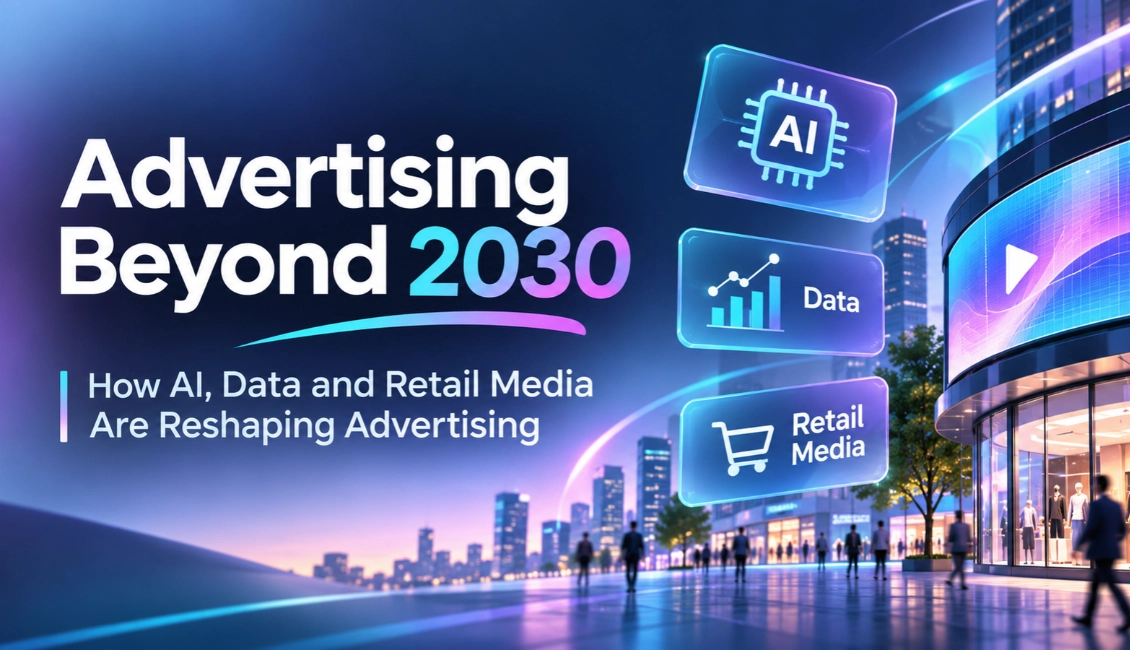
Three developments are likely to shape advertising by 2030: the growth of retail media networks, the next stage of programmatic buying and the arrival of AI agents.
First-Party Data Remains Important
Google’s decision showed that a plan built on a single technology can change at short notice. Third-party cookies are still available under Chrome’s controls. Other browsers follow different rules, and privacy laws affect how companies collect customer information.
First-party data is information that a business gathers directly from its customers, for example through loyalty programmes, registrations and purchases. A larger volume does not make the data more useful. Companies need accurate records, proper consent and a clear purpose for each type of information they hold. Data without a purpose should not be collected.
Retail Media Networks
Retail media networks (RMNs) allow retailers to sell advertising space on their websites, apps, physical stores and other digital channels. Brands use them to reach people who are already shopping or searching for a product.
Forrester forecasts that global retail media spending will rise from US$184 billion in 2025 to US$312 billion in 2030, an annual growth rate of about 11%. Sponsored product listings were the first major format. Retailers now offer other options that support brand awareness and reach new audiences. A brand that does not sell through a given retailer can still buy advertising on its network.
For marketers, the main question is whether a network reaches the intended audience and produces better results.
Offsite Advertising and Connected TV
A retailer has limited space on its own websites and apps. Offsite advertising extends its reach to other sites and apps, and the retailer’s audience data is used to select who sees each advertisement.
Connected TV (CTV) adds another channel, which includes internet-connected televisions and streaming services. A person may see an advertisement on a streaming service and buy the product online later. Advertisers can use available data to examine whether campaigns link to purchases. This brings brand advertising, which aims at awareness, closer to performance marketing, which aims at measurable actions such as purchases or registrations.
A link in the data does not show cause, because the buyer may have made the purchase without seeing the advertisement. Reliable measurement is required to separate the two.
Programmatic 3.0
Programmatic advertising uses software to buy and sell digital advertising space automatically. Its next stage is likely to involve better placement control, clearer costs and AI-assisted decisions. Programmatic 3.0 is an informal label for this direction, and no industry body has defined it as a standard.
Control over placements
Advertisers want to know where their advertisements appear and what share of the budget reaches customers. Curated marketplaces and private deals allow them to select publishers and advertising space. Such deals still require checks on audience quality and fees, as well as a review of campaign results.
AI agents
AI agents could plan campaigns and compare advertising options. They could also manage budgets and suggest changes based on performance. Marketing teams could assign routine tasks to these agents and review results sooner.
Poor data, unclear goals and weak measurement would still lead to poor decisions, whatever tool is used. A reasonable starting point is reporting and basic optimisation. People should review any decision that involves a large budget or sensitive customer data. Automation is worth using where it improves the work.
Southeast Asia
Research by GrabAds and Kantar projected that retail media spending in the region would reach US$4.7 billion by 2030. The same research found that 62% of surveyed brands already included retail media in their plans.
The region consists of several markets, each with its own shopping habits, popular platforms and customer expectations. A strategy that works in one country may perform worse in another. Businesses in Singapore and other markets should study each platform’s audience, measurement methods and reach before they invest. The choice of platform matters more than the pace of the trend.
What Marketers Should Do Before 2030
Businesses do not need to adopt every new technology at once. Five practical steps are enough to begin.
- Build better first-party data. Collect useful customer information with consent and keep it accurate.
- Test retail media. Set a clear goal and check whether campaigns improve reach, sales or engagement.
- Measure the full impact. Evaluate brand awareness and sales together, since a single number gives an incomplete picture.
- Check advertising costs. Find out what the media charges and technology fees are, and where the rest of the budget goes.
- Test AI with care. Begin with simple tasks, review the results and extend its responsibilities only when it proves useful.
Conclusion
By 2030, retail media, connected TV and programmatic advertising could be more closely linked, and AI agents may handle a larger share of routine work. The pace of change is hard to predict, and industry forecasts may differ from actual results.
Reliable data, transparent costs and sound measurement will remain necessary. Companies that choose their tools with care and understand their customers will be better placed to decide where their advertising money goes.
References
Sources for the figures in the article
- Forrester, “Global Retail Media Spend To Top $300 Billion By 2030” (blog, 9 October 2025). Forrester forecasts that global retail media spending will grow from $184 billion in 2025 to $312 billion by 2030, a compound annual growth rate of 11%.
https://www.forrester.com/blogs/global-retail-media-forecast-2030 - Marketing-Interactive, “Study: SEA retail media network ad spend to hit US$4.7 billion by 2030.” The study by GrabAds and Kantar projects US$4.7 billion in regional retail media network spending by 2030, and it found that 62% of brands in the region already include retail media in their media plans.
https://www.marketing-interactive.com/study-sea-retail-media-networks-advertising-spend-to-hit-us-4-7-billion-by-2030 marketing-interactive - Google Privacy Sandbox, Anthony Chavez, “Next steps for Privacy Sandbox and tracking protections in Chrome” (22 April 2025). This is the original announcement.
https://privacysandbox.google.com/blog/privacy-sandbox-next-steps - Hunton Andrews Kurth, “Google Announces Next Steps for Privacy Sandbox and Tracking Protections in Chrome Browser.” Google confirmed on 22 April 2025 that Chrome will continue to offer third-party cookies and will not add a standalone prompt for cookie preferences.
https://hunton.com/privacy-and-information-security-law/google-announces-next-steps-for-privacy-sandbox-and-tracking-protections-in-chrome-browser - Stape, “Google Chrome: Cookie deprecation explained.” The page describes cookies as available by default in Chrome and managed through the existing settings. This supports the sentence on Chrome’s controls.
https://stape.io/news/google-chrome-cookie-deprecation - AdNews, “IAB Tech Lab details agentic advertising standards” (12 January 2026). The IAB Tech Lab roadmap describes how agentic buying and selling can scale by extending existing industry standards.
https://www.adnews.com.au/news/iab-tech-lab-details-agentic-advertising-standards - PPC Land, “How IAB Tech Lab plans to prevent agentic AI’s fragmentation problem.” The IAB Tech Lab released its Deal API specification on 5 December 2025, which addresses transparency gaps in curated programmatic deals. This supports the point about checking curated deals.
https://ppc.land/how-iab-tech-lab-plans-to-prevent-agentic-ais-fragmentation-problem
Key trends include AI-powered media buying, retail media networks, first-party data, connected TV advertising and advanced programmatic technologies.
Programmatic 3.0 refers to the next stage of programmatic advertising, using AI and automation to improve media buying, audience targeting, campaign optimisation and transparency.
Not necessarily. Their use will depend on browser policies, privacy regulations and consumer choices. Advertisers should focus on first-party data and privacy-conscious measurement.
Retail media networks allow brands to advertise on retailers' websites, apps and other platforms using shopping-related insights to reach potential customers.
Businesses should invest in first-party data, explore AI-powered advertising, adopt retail media strategies and improve campaign measurement while maintaining data privacy and human oversight.