
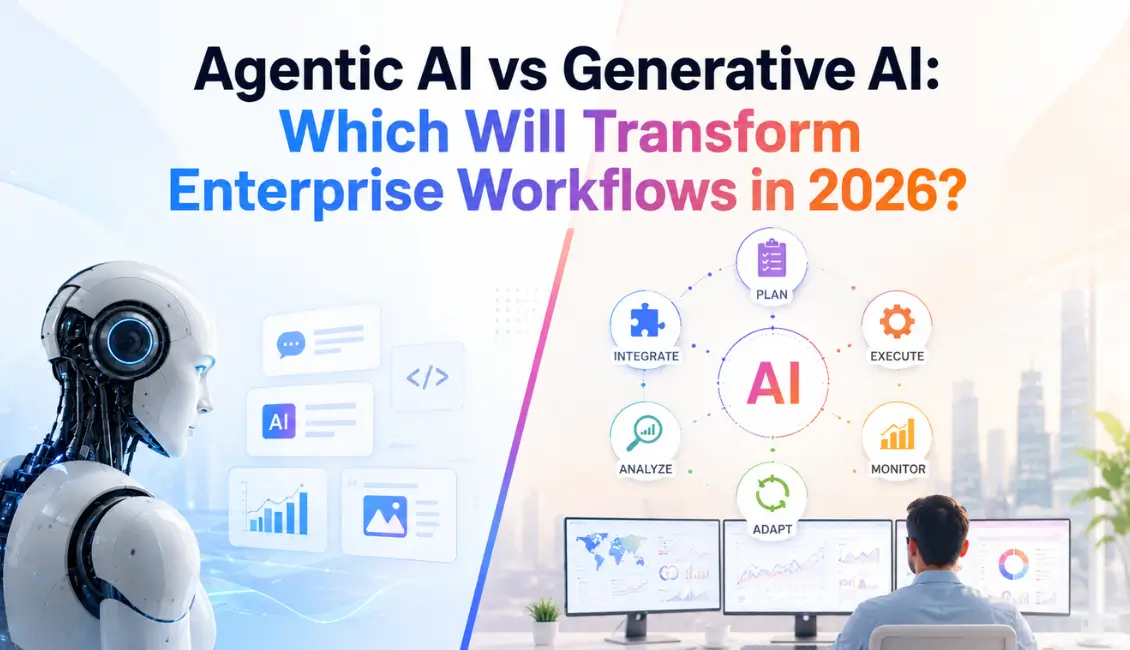
As enterprises move beyond AI experimentation, a new question is taking center stage: Will Generative AI continue to dominate, or is Agentic AI the technology that will truly transform business operations?
Artificial Intelligence has evolved at an extraordinary pace over the past few years. What started as AI-powered chatbots and content generators has quickly progressed into intelligent systems capable of making decisions, coordinating complex tasks, and executing entire business processes with minimal human intervention.
For enterprise leaders, the conversation has shifted from “How can AI improve productivity?” to “How can AI operate entire workflows?”
This shift is driving one of the biggest technology debates of 2026—Agentic AI vs Generative AI.
While Generative AI has already reshaped industries by creating content, writing code, summarizing reports, and assisting employees, Agentic AI promises something much bigger: autonomous execution of business processes.
For CIOs, CTOs, digital transformation leaders, and enterprise decision-makers, understanding the difference between these technologies isn’t just a technical exercise—it could determine the future competitiveness of their organizations.
As discussions at leading events like AI Conference 2026 and AI Summit India 2026 increasingly focus on enterprise AI adoption, one question continues to emerge:
Which AI technology will truly replace enterprise workflows by 2026?
The answer isn’t as straightforward as choosing one over the other.
Executive Summary
Before diving deeper, here’s the short answer.
Generative AI excels at creating content, answering questions, writing code, generating designs, and assisting humans with individual tasks.
Agentic AI, on the other hand, goes a step further. It doesn’t just generate an answer—it plans, decides, executes, monitors progress, and adapts until an objective is achieved.
Think of it this way:
- Generative AI is an intelligent assistant.
- Agentic AI is an autonomous teammate.
This distinction is becoming increasingly important because enterprise success is no longer measured by how quickly employees create documents—it is measured by how efficiently organizations execute workflows.
According to Gartner, nearly 40% of enterprise applications are expected to incorporate AI agents by 2026, highlighting the industry’s rapid shift toward autonomous systems. While adoption is accelerating, governance, security, and organizational readiness remain critical challenges that businesses must address before scaling Agentic AI across mission-critical operations.
The organizations that understand how to combine both technologies—not replace one with the other—will likely emerge as AI leaders over the next decade.
Understanding Generative AI
Generative AI became a global phenomenon after tools like ChatGPT, Gemini, Claude, and Microsoft Copilot demonstrated how machines could create remarkably human-like content within seconds.
Instead of following predefined rules, these systems use Large Language Models (LLMs) trained on massive datasets to generate original outputs based on user prompts.
Today, Generative AI can create:
- Articles and blogs
- Marketing campaigns
- Software code
- Product descriptions
- Business reports
- Images and videos
- Customer responses
- Meeting summaries
For enterprises, this translates into faster content production, improved employee productivity, and reduced manual effort.
A simple example
Imagine asking an AI assistant:
“Create a quarterly sales report based on this spreadsheet.”
Generative AI will analyze the data, identify trends, and generate a polished report in seconds.
Once the report is delivered, however, its job is complete.
It doesn’t email stakeholders.
It doesn’t schedule review meetings.
It doesn’t monitor KPIs next month.
It simply responds to the prompt.
This is why Generative AI is often described as reactive AI.
It waits for instructions before taking action.
What Is Agentic AI?
Agentic AI represents the next stage in enterprise intelligence.
Instead of waiting for prompts, Agentic AI works toward achieving objectives.
It can:
- Break complex goals into smaller tasks
- Decide the sequence of actions
- Access enterprise applications
- Interact with APIs
- Retrieve information
- Collaborate with multiple AI agents
- Learn from previous actions
- Adapt when conditions change
Rather than functioning as a chatbot, Agentic AI behaves more like a digital employee.
Imagine assigning this objective:
“Reduce customer complaint resolution time by 30%.”
Instead of merely suggesting ideas, an Agentic AI system could:
- Analyze historical support tickets.
- Identify recurring issues.
- Prioritize high-impact cases.
- Assign work automatically.
- Draft personalized responses.
- Update the CRM.
- Escalate unresolved issues.
- Generate weekly performance reports.
- Recommend workflow improvements.
No continuous prompting required.
The AI continuously works toward completing the objective while adapting to new information along the way.
This ability to execute multi-step processes is why many analysts believe Agentic AI represents the next major evolution of enterprise automation.
Generative AI vs Agentic AI: The Fundamental Difference
Although both technologies rely on advanced AI models, they solve very different business problems.
| Feature | Generative AI | Agentic AI |
| Primary Purpose | Creates content | Completes objectives |
| Behaviour | Reactive | Proactive |
| Workflow | Single-step | Multi-step |
| Human Involvement | Frequent prompting | Strategic oversight |
| Decision Making | Limited | Continuous |
| Enterprise Value | Productivity enhancement | Workflow transformation |
A useful analogy is to compare them with employees.
A copywriter creates excellent marketing content when assigned a task.
A project manager coordinates teams, manages deadlines, allocates resources, solves problems, and ensures the project reaches completion.
Generative AI behaves like the copywriter.
Agentic AI behaves like the project manager.
Both are valuable—but their roles are fundamentally different.
How the Technology Works
Understanding the underlying architecture helps explain why these technologies produce such different outcomes.
Generative AI Architecture
Generative AI typically follows a straightforward workflow:
User Prompt → Large Language Model → Generated Output
The model processes the prompt, predicts the most likely sequence of words (or pixels in image generation), and delivers a response.
Each interaction is largely independent.
Unless conversation memory is intentionally maintained, the model doesn’t plan future actions or execute follow-up tasks.
Its strength lies in generating high-quality outputs quickly.
Agentic AI Architecture
Agentic AI introduces several additional layers that enable autonomous decision-making.
A typical enterprise agent includes:
- Planning Engine – Breaks goals into manageable tasks.
- Memory Layer – Stores context, previous actions, and learning.
- Reasoning Module – Evaluates different approaches before acting.
- Tool Integration – Connects with CRMs, ERPs, databases, APIs, email systems, and enterprise software.
- Execution Layer – Performs tasks automatically.
- Feedback Loop – Monitors results and adjusts strategies when necessary.
Instead of producing a single response, the system continuously cycles through planning, execution, evaluation, and improvement.
This architecture enables Agentic AI to manage complex workflows that previously required multiple employees working across different departments.
Why This Debate Matters in 2026
Enterprise AI is entering a new phase.
The first wave focused on helping employees work faster.
The next wave is focused on helping organizations operate smarter.
This distinction explains why AI Conference 2026 agendas are increasingly centered on autonomous AI agents, enterprise governance, multi-agent systems, and AI-powered business orchestration. Similarly, conversations at AI Summit India 2027 are expected to emphasize responsible AI adoption, workforce transformation, and scalable enterprise automation.
The question is no longer whether AI can assist employees.
The real question is:
Can AI independently execute entire business workflows while remaining secure, compliant, and trustworthy?
That is where the comparison between Generative AI and Agentic AI becomes more than a technology discussion—it becomes a strategic business decision.
Enterprise Applications: Where Each Technology Creates Business Value
Understanding the technical differences between Generative AI and Agentic AI is only the beginning. The real question for enterprise leaders is:
Where does each technology deliver the greatest business impact?
The answer depends on the complexity of the task.
Generative AI shines when organizations need creativity, analysis, and content generation. Agentic AI becomes invaluable when businesses want to automate end-to-end workflows involving multiple systems, approvals, and decisions.
Rather than replacing each other, these technologies increasingly work together.
Generative AI provides the intelligence.
Agentic AI provides the execution.
Let’s explore how this plays out across industries.
Enterprise Use Cases Across Industries
-
Customer Service: From Faster Responses to Autonomous Resolution
Customer service has been one of the earliest adopters of AI.
Today, Generative AI helps support teams by:
- Drafting personalized email responses
- Summarizing customer conversations
- Translating messages into multiple languages
- Suggesting troubleshooting steps
- Creating knowledge base articles
These capabilities significantly improve agent productivity but still require human intervention.
Agentic AI takes customer service much further.
Instead of simply suggesting a response, an AI agent can:
- Understand the customer’s issue
- Retrieve purchase history
- Verify warranty eligibility
- Check inventory
- Schedule a replacement
- Update the CRM
- Notify logistics teams
- Send confirmation emails
- Follow up after resolution
The customer experiences one seamless interaction instead of multiple handoffs between departments.
For organizations handling thousands of service requests daily, this level of automation can dramatically reduce resolution times while improving customer satisfaction.
-
Sales & Marketing: Beyond Content Creation
Marketing teams were among the first to embrace Generative AI.
Today it assists with:
- Blog writing
- Social media posts
- Product descriptions
- Email campaigns
- Ad copy
- SEO optimization
- Video scripts
Sales teams also benefit through personalized outreach and proposal generation.
Agentic AI expands these capabilities into complete revenue workflows.
Imagine a qualified lead downloading your whitepaper.
Instead of notifying a salesperson, an AI agent could:
- Score the lead using CRM data
- Research the prospect’s company
- Generate personalized outreach
- Schedule a meeting
- Update Salesforce automatically
- Recommend pricing
- Prepare meeting briefs
- Assign follow-up tasks
- Track deal progression
Instead of helping sales representatives write better emails, Agentic AI helps entire sales organizations move deals faster through the pipeline.
-
IT Operations and Enterprise Infrastructure
Enterprise IT teams face increasing pressure to maintain complex digital environments while minimizing downtime.
Generative AI assists by:
- Explaining system logs
- Recommending fixes
- Writing scripts
- Creating documentation
- Summarizing incidents
Agentic AI introduces autonomous IT operations.
An intelligent operations agent can:
- Detect abnormal server behavior
- Diagnose root causes
- Restart affected services
- Deploy approved patches
- Notify stakeholders
- Open incident tickets
- Monitor system health after deployment
Instead of waiting for engineers to intervene, the AI continuously works toward restoring normal operations.
This represents one of the most promising applications of autonomous enterprise AI.
-
Human Resources and Administration
HR departments spend significant time on repetitive administrative tasks.
Generative AI helps create:
- Job descriptions
- Employee handbooks
- Learning content
- Interview questions
- Internal communications
Agentic AI can coordinate entire HR workflows.
For example, when a candidate accepts an offer, an AI agent can automatically:
- Initiate background verification
- Generate employment documents
- Schedule onboarding sessions
- Request IT equipment
- Create user accounts
- Assign mandatory training
- Notify department managers
- Monitor onboarding completion
The result is a smoother employee experience with minimal manual coordination.
Industry-Specific Applications
While every sector benefits from AI differently, Agentic AI is rapidly emerging as the next competitive advantage across highly regulated and operationally intensive industries.
Banking & Financial Services
Banks have already embraced Generative AI for report generation, compliance documentation, and customer communication.
Agentic AI extends automation into:
- Fraud investigation
- Risk assessment
- Portfolio monitoring
- Loan processing
- Regulatory reporting
- Customer onboarding
Rather than assisting analysts, AI agents coordinate activities across multiple banking systems while ensuring compliance requirements are met.
Healthcare
Healthcare organizations manage enormous volumes of administrative work alongside patient care.
Generative AI assists clinicians by summarizing patient records, drafting discharge summaries, and generating documentation.
Agentic AI supports:
- Appointment scheduling
- Patient triage
- Treatment coordination
- Insurance verification
- Prescription follow-ups
- Resource allocation
Importantly, these systems still operate under human clinical oversight, ensuring patient safety remains the highest priority.
Manufacturing
Manufacturers increasingly rely on connected factories and industrial IoT systems.
Generative AI helps engineers generate maintenance reports and technical documentation.
Agentic AI enables predictive operations by:
- Monitoring sensor data
- Predicting equipment failures
- Scheduling maintenance
- Coordinating spare parts
- Optimizing production schedules
- Managing supply chain disruptions
Instead of reacting to failures, manufacturers can prevent them before they occur.
Retail & E-Commerce
Retailers use Generative AI to produce:
- Product descriptions
- Personalized recommendations
- Marketing campaigns
- Customer support responses
Agentic AI transforms backend operations by autonomously managing:
- Inventory replenishment
- Pricing adjustments
- Warehouse coordination
- Delivery optimization
- Supplier communications
The result is a more responsive supply chain capable of adapting to real-time demand fluctuations.
Leading Enterprise AI Platforms
As enterprise adoption accelerates, major technology providers are racing to build comprehensive AI ecosystems.
Some organizations focus on foundational AI models, while others specialize in autonomous agent platforms.
| Platform | Primary Strength | Best Fit |
| OpenAI | Advanced language models | Content creation & copilots |
| Microsoft Copilot | Microsoft ecosystem integration | Enterprise productivity |
| Google Gemini | Multimodal AI & cloud ecosystem | Data-driven enterprises |
| Salesforce Agentforce | CRM automation | Sales & customer service |
| ServiceNow AI Agents | Enterprise workflows | IT & operations |
| UiPath | Robotic Process Automation + AI | Process automation |
| Anthropic Claude | Secure enterprise AI | Knowledge-intensive organizations |
Increasingly, enterprises are combining multiple platforms instead of relying on a single vendor. The emphasis has shifted from selecting the “best AI model” to building an integrated AI ecosystem that aligns with existing business processes, security requirements, and governance policies.
What Does Successful Implementation Require?
Adopting Agentic AI involves much more than purchasing new software.
Enterprise success depends on several foundational elements.
Data Readiness
AI systems are only as effective as the data they access.
Organizations should prioritize:
- Unified enterprise data
- Clean master data
- API accessibility
- Real-time information sharing
- Strong metadata governance
Poor-quality data inevitably leads to poor AI decisions.
Integration Across Enterprise Systems
Unlike standalone chatbots, AI agents must interact with multiple business applications.
Typical integrations include:
- CRM platforms
- ERP systems
- HR software
- Finance applications
- Cloud infrastructure
- Customer support tools
- Business intelligence platforms
The more seamlessly these systems communicate, the greater the value AI agents can deliver.
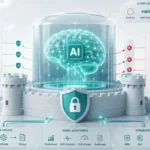
Governance and Security
Greater autonomy requires stronger oversight.
Leading organizations are establishing AI governance frameworks that define:
- Human approval thresholds
- Data access permissions
- Audit trails
- Monitoring mechanisms
- Ethical guidelines
- Regulatory compliance
This ensures AI remains trustworthy while operating at enterprise scale.
Enterprise Adoption Trends Toward 2026
The rapid rise of Generative AI has prepared organizations for a much larger transformation.
Industry analysts now predict that enterprise AI will evolve through three distinct phases.
Phase 1: AI Assistants (2023–2024)
Organizations focused primarily on improving employee productivity through chatbots, writing assistants, and coding copilots.
Phase 2: AI Copilots (2025)
AI became embedded within enterprise software, assisting employees across CRM, ERP, HR, finance, and customer service platforms.
Phase 3: AI Agents (2026 and Beyond)
The next stage introduces autonomous AI capable of executing complete workflows with limited human supervision.
Industry forecasts indicate this transition is accelerating rapidly:
- Gartner projects that around 40% of enterprise applications will incorporate AI agents by 2026.
- Many large enterprises are expected to move beyond isolated pilots toward organization-wide AI orchestration.
- Technology, financial services, manufacturing, and telecommunications are likely to lead adoption, while sectors with stricter regulatory requirements may adopt a more phased approach.
The focus is no longer on whether AI can generate better content.
The focus is whether AI can become a trusted operational partner across the enterprise.
Measuring ROI: From Productivity to Business Transformation
Every AI initiative must ultimately demonstrate measurable business value.
Generative AI typically delivers quick productivity gains.
Common KPIs include:
- Time saved creating content
- Faster report generation
- Reduced software development effort
- Improved employee efficiency
Agentic AI introduces a broader set of enterprise metrics.
Organizations should measure:
| KPI | Business Impact |
| Workflow completion time | Faster operations |
| Percentage of automated tasks | Reduced manual effort |
| Cost per transaction | Operational savings |
| Customer satisfaction (CSAT) | Better service quality |
| Employee productivity | Higher output |
| Process error rates | Improved accuracy |
| Revenue per employee | Greater business efficiency |
Although Agentic AI generally requires higher initial investment in infrastructure, integration, and governance, it also has the potential to unlock transformational returns by redesigning how work gets done across the enterprise.
Risks and Challenges: Why Agentic AI Requires Responsible Adoption
The promise of Agentic AI is compelling, but greater autonomy also introduces greater responsibility. Unlike Generative AI, which typically responds to prompts and waits for further instructions, Agentic AI can make decisions, interact with enterprise systems, and execute actions independently. Without appropriate governance, these capabilities can create operational, security, and compliance risks.
The challenge for enterprises isn’t whether to adopt Agentic AI—it’s how to adopt it responsibly.
Key Risks Enterprises Must Address
- Autonomous Decision-Making
AI agents may occasionally make decisions based on incomplete, outdated, or inaccurate information. In high-stakes environments such as finance, healthcare, or critical infrastructure, even small errors can have significant business consequences.
Mitigation Strategies:
- Keep humans in the approval loop for high-risk decisions.
- Define clear operational boundaries for AI agents.
- Use approval workflows before executing critical actions.
- Data Privacy & Security
Agentic AI often requires access to multiple enterprise systems including CRM, ERP, HRMS, finance applications, and customer databases.
Without proper controls, excessive permissions increase cybersecurity risks.
Organizations should implement:
- Role-based access control (RBAC)
- Zero Trust security architecture
- Encryption of sensitive data
- Comprehensive audit logging
- Continuous monitoring of AI activities
Every action performed by an AI agent should be transparent and traceable.
- Bias and Ethical Concerns
AI systems inherit biases from training data.
If left unchecked, these biases may influence hiring recommendations, loan approvals, insurance decisions, or customer interactions.
Responsible AI practices include:
- Regular fairness audits
- Diverse training datasets
- Explainable AI techniques
- Human review for people-impacting decisions
Responsible AI is not only an ethical responsibility—it is increasingly becoming a regulatory expectation.
- Reliability and Operational Resilience
Enterprise workflows are interconnected.
If one AI agent fails, it can affect downstream processes across departments.
Organizations should establish:
- Backup workflows
- Human takeover mechanisms
- Continuous monitoring dashboards
- Automated alerting systems
- Disaster recovery procedures
Autonomous systems should always fail safely.
Governance and Compliance: The Foundation of Enterprise AI
As AI capabilities mature, governance is becoming just as important as technological innovation.
Enterprise leaders should establish an AI Governance Board comprising representatives from:
- IT
- Security
- Legal
- Compliance
- HR
- Business Operations
- Executive Leadership
This cross-functional approach ensures AI initiatives align with organizational objectives while managing legal and ethical risks.
Regulatory Considerations
Several global regulations are shaping enterprise AI adoption, including:
- EU AI Act
- GDPR (General Data Protection Regulation)
- HIPAA (Healthcare)
- PCI DSS (Financial Services)
- Emerging AI governance frameworks in India and other regions
Organizations should ensure their AI systems provide:
- Explainable decisions
- Audit trails
- Data lineage
- Human accountability
- Risk documentation
As discussions at AI Summit India 2026 continue to emphasize responsible innovation, Indian enterprises are increasingly expected to balance AI-driven efficiency with transparency, workforce development, and regulatory compliance.
The future of enterprise AI will be defined not only by intelligence but also by trust.
Enterprise Roadmap: Preparing for the Agentic AI Era
Organizations don’t need to replace existing Generative AI investments to benefit from Agentic AI. Instead, they should build a phased transformation roadmap that combines quick productivity wins with long-term operational automation.
Phase 1: Identify High-Value Opportunities
Start with processes that are:
- Repetitive
- Rule-based
- Time-consuming
- High in operational cost
- Low in regulatory risk
Examples include customer support triage, invoice processing, employee onboarding, and IT ticket routing.
Phase 2: Strengthen the Data Foundation
Successful AI depends on high-quality enterprise data.
Key priorities include:
- Centralized data governance
- API-driven integration
- Master data management
- Real-time analytics
- Secure cloud infrastructure
Clean data is the fuel that powers intelligent automation.
Phase 3: Pilot Agentic Workflows
Rather than attempting enterprise-wide transformation immediately, organizations should begin with focused pilots.
Measure:
- Time saved
- Process accuracy
- Employee satisfaction
- Customer experience
- Operational costs
Successful pilots create internal confidence and justify broader investment.
Phase 4: Scale Responsibly
Once governance, security, and ROI are established, organizations can gradually expand Agentic AI across multiple business functions.
This stage includes:
- Multi-agent collaboration
- Cross-department automation
- Enterprise orchestration
- Continuous optimization
- Performance monitoring
Transformation should be incremental—not disruptive.
Phase 5: Build an AI-Ready Workforce
Technology alone does not create transformation.
Employees must learn how to collaborate with AI rather than compete against it.
Future enterprise roles may include:
- AI Operations Manager
- Prompt Engineer
- AI Governance Lead
- AI Security Specialist
- Workflow Automation Architect
- AI Ethics Advisor
Organizations that invest equally in technology and people will be better positioned for long-term success.
Final Verdict: Will Agentic AI Replace Enterprise Workflows in 2026?
The short answer is yes—but not in the way many people expect.
Agentic AI is unlikely to replace every enterprise workflow overnight, nor will it eliminate the need for Generative AI. Instead, 2026 will mark the beginning of a new operational model where intelligent AI agents work alongside employees, orchestrating routine tasks, coordinating systems, and executing business processes with increasing autonomy.
Generative AI will remain the creative engine—powering conversations, generating content, writing code, and assisting knowledge workers.
Agentic AI will become the execution layer—planning tasks, interacting with enterprise applications, and driving end-to-end workflow automation.
The real winners won’t be organizations that choose one technology over the other.
They’ll be the ones that successfully integrate both into a unified enterprise AI strategy.
As conversations at AI Conference 2027 India continue to highlight, the future belongs to organizations that move beyond isolated AI tools and embrace intelligent, governed, and scalable automation.
The question for enterprise leaders is no longer:
“Should we adopt AI?”
The more important question is:
“How quickly can we redesign our business around AI-powered workflows while maintaining trust, governance, and human oversight?”
The organizations that answer this question effectively will define the next era of enterprise innovation.
Conclusion
The debate between Agentic AI and Generative AI is not about identifying a single winner—it’s about understanding how each technology contributes to the future of work.
Generative AI has already transformed how employees create, communicate, and collaborate. Agentic AI is now redefining how enterprises execute, automate, and optimize operations at scale.
Together, these technologies represent the next frontier of digital transformation—one where humans focus on strategy, creativity, and innovation while intelligent AI systems handle repetitive, data-intensive, and operational tasks.
For CIOs, CTOs, business leaders, and digital transformation teams, the opportunity is clear: start experimenting today, build governance from the outset, and prepare your organization for a future where AI is not just a tool—but an active participant in enterprise success.
Join the Conversation
The future of enterprise AI is unfolding now-and the leaders who engage today will help shape what comes next.
Want to explore Agentic AI, Generative AI, enterprise automation and the future of intelligent workflows with industry professionals?
Whether you’re interested in attending, speaking, sponsoring, exhibiting or partnering, connect with the DigitalConfex team.
The future of enterprise workflows won’t simply be automated—it will be intelligently orchestrated. Are you ready?




[…] Agentic marketing and AI transformation […]