Introduction: SEO Has Changed – Have You?
Let’s be honest. If you’re still doing SEO the same way you were doing it three years ago, you’re probably not seeing the results you used to. And it’s not because you’re doing something wrong, exactly. It’s because the whole game has shifted.
In 2026, AI is everywhere in search. Google’s AI Overviews, Bing’s AI-powered answers, and tools like Perplexity are changing how people find information online. Instead of scrolling through ten blue links, users are getting direct, conversational answers – generated by AI – right at the top of the page.
That means the old playbook – stuff your page with keywords, grab as many backlinks as you can, churn out blog posts – just doesn’t cut it anymore. What works now is something smarter, deeper, and more human. It’s called AI-driven optimization, and this article is going to break down exactly what it is, why it matters, and how you can start using it today.
How SEO Got to Where It Is Today
SEO didn’t change overnight. It’s been evolving for decades, and honestly, it’s always been a bit of a cat-and-mouse game between marketers and search engines.
Back in the early 2000s, search engines were pretty basic. You wanted to rank? You repeated your keyword as many times as possible and got as many links pointing to your site as you could find. Simple. Effective. And, let’s face it, a little ridiculous in hindsight.
Then Google started getting smarter. The Panda and Penguin updates in the 2010s cracked down on low-quality content and spammy links. RankBrain in 2015 was a big turning point – it was Google’s first machine learning algorithm, and it started focusing on what people actually meant when they searched, not just the exact words they typed.
Fast forward to today, and we’re in a completely different era. Large language models (LLMs) – the same technology behind ChatGPT – are now powering search engines. These systems don’t just match keywords. They understand language, context, relationships between ideas, and the intent behind a question.
The big question now isn’t just ‘Can I rank on page one?’ It’s ‘Will AI recommend my content when someone asks a question in my space?’
Why the Old Tactics Just Don’t Work Anymore
Here’s something a lot of marketers don’t want to hear: some of the strategies you’ve been using could actually be hurting you now.
Take keyword stuffing. Even if you’re not doing it aggressively, writing content that’s clearly built around repeating a phrase over and over feels unnatural — and AI systems pick up on that immediately. They’re trained on billions of pieces of human writing. They know what helpful, natural content looks like, and they know when something feels forced.
Basic backlink building is another one. Getting a bunch of links from random directories, irrelevant blogs, or low-quality sites used to move the needle. Now, search engines look at whether a link actually makes sense – is it from a site that’s relevant to your topic? Does it add genuine context? A handful of great links from trusted sources in your industry is worth far more than hundreds of low-quality ones.
And thin content – those short, surface-level blog posts written purely to rank for one keyword? When AI can generate a comprehensive, expert-level answer in seconds by pulling from thousands of authoritative sources, a 400-word post with no real depth simply won’t compete.
Here are the tactics that are now doing more harm than good:
- Writing pages around a single keyword without covering the broader topic properly
- Publishing lots of short, low-effort articles just to increase your content volume
- Chasing backlinks from sites that have nothing to do with your industry
- Ignoring how users actually engage with your content — things like time on page, bounce rate, and clicks
- Forgetting about voice search and conversational queries, which are growing fast
Traditional SEO vs AI-Driven SEO: What Has Changed?
To better understand how search optimisation has evolved, it’s helpful to compare the priorities of traditional SEO with the strategies required for AI-driven search in 2026.
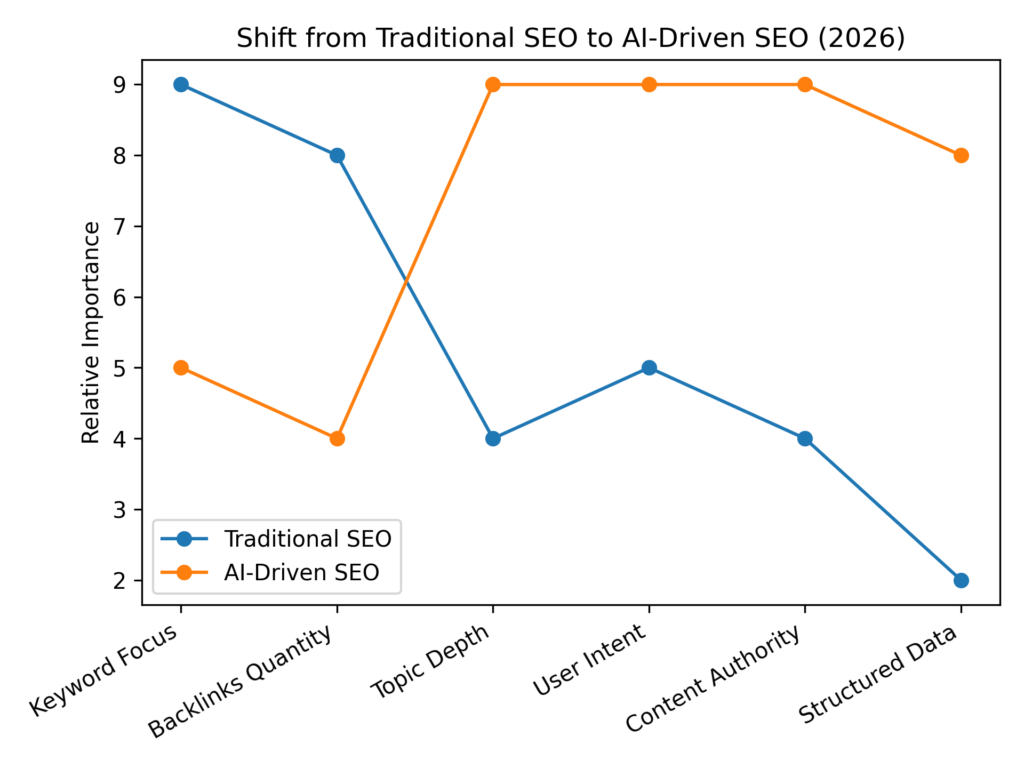
Comparison Table
| Traditional SEO | AI-Driven SEO |
|---|---|
| Focus on keywords | Focus on topics & entities |
| Backlink quantity | Backlink quality & relevance |
| Short keyword articles | Comprehensive topic clusters |
| Ranking positions | AI recommendations & citations |
| Manual optimization | AI-assisted optimization |
How AI Search Engines Actually Read Your Content
To win at AI SEO, you need to understand how these systems think. And I promise it’s not as complicated as it sounds.
AI search engines don’t read your page the way you’re reading this article right now. They’re not going line by line looking for your keyword. Instead, they’re analysing the whole picture – what topics does this page cover, how well does it cover them, and does it genuinely help someone who has this question?
One of the biggest things they look at is intent. When someone types a question into a search engine, the AI tries to figure out what that person is really trying to accomplish. Are they looking for information? Trying to buy something? Comparing options? Your content needs to match that intent – not just contain the right words.
They also look at depth and context. A page about ‘content marketing’ that only gives a basic definition won’t impress an AI system. But a page that covers the strategy, the tools, the metrics, the common mistakes, and the real-world examples? That signals genuine expertise.
Then there’s entity understanding. AI systems map out the relationships between people, brands, concepts, and ideas. When your content clearly connects these dots – for example, linking your discussion of ’email marketing’ to related concepts like automation, segmentation, and customer journeys — it becomes much easier for AI to understand and recommend.
Finally, trust matters more than ever. Google’s E-E-A-T framework (Experience, Expertise, Authoritativeness, Trustworthiness) isn’t just a box to tick. AI systems are increasingly good at detecting whether a piece of content was written by someone who actually knows their stuff or whether it was churned out for clicks.
What AI-Driven Optimisation Actually Looks Like
So what do you actually need to focus on? Here are the key building blocks of a modern, AI-ready SEO strategy:
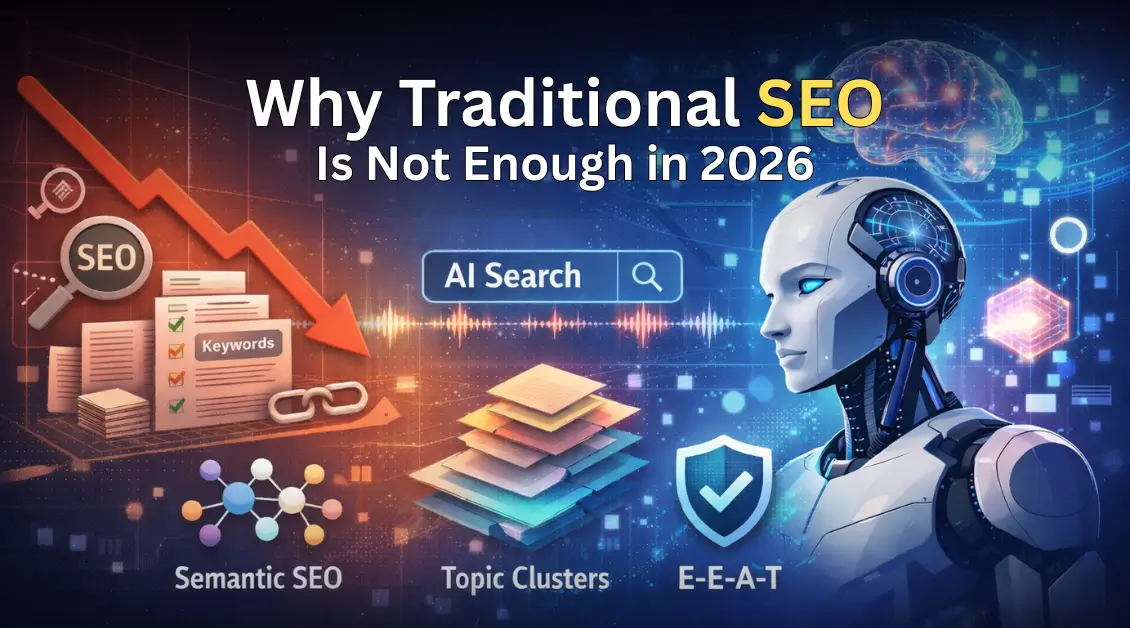
- Semantic SEO: Instead of targeting one keyword, you’re optimising around a whole topic – covering all the related questions, concepts, and subtopics that belong to it
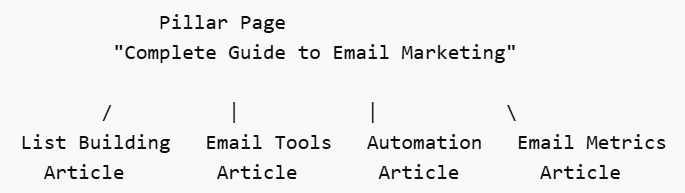
- Topic clusters: You build a main ‘pillar’ page that covers a broad topic in depth, and then create supporting pages that go deep on each subtopic – all linked together
- Structured data and schema markup: This is code you add to your pages that helps AI systems understand what your content is about – things like FAQs, reviews, product info, and author details
- E-E-A-T signals: Show who wrote your content, what their credentials are, where they’ve been published, and why they’re a trusted voice on the topic
- Conversational content: Write the way people talk — answer questions directly, use natural language, and structure your content so it works well for voice search and AI chatbots
- Fresh, updated content: AI systems favour content that’s kept current. Regularly reviewing and updating your existing pages is just as important as publishing new ones
- Smart internal linking: Connect your related pages logically, so both users and AI can navigate your full body of expertise easily
Real-World Examples: What This Looks Like in Practice
Let’s make this concrete. One of the biggest practical changes you can make is shifting from single keyword pages to topic clusters. Here’s a simple example.
Say you run a digital marketing agency and you want to rank for ’email marketing.’ The old approach: publish one page called ‘Email Marketing Services’ and optimise it for that phrase. The new approach: build a whole content cluster around the topic.
- Pillar page: A complete guide to email marketing in 2026 – covering strategy, tools, metrics, and best practices all in one place
- Supporting page 1: How to grow an email list from scratch – ethical, effective tactics that actually work
- Supporting page 2: The best email marketing platforms compared – features, pricing, AI capabilities, and who each one is best for
- Supporting page 3: Email open rate benchmarks by industry – and how to beat them
- Supporting page 4: How to build automated email sequences that guide customers through a buying journey
All of these pages link to each other and back to the pillar page. When an AI search engine is deciding who to recommend as an authority on email marketing, this cluster screams expertise. It covers the topic from every angle. It helps real people with real questions. That’s exactly what AI systems are looking for.
Here’s another example. A SaaS company selling project management software shouldn’t just focus on ranking for ‘project management software.’ They should create content around all the connected topics their audience cares about – team collaboration, agile methodology, remote work productivity, OKR goal setting, sprint planning. That web of related content builds topical authority that AI systems recognise and reward.
Practical Steps You Can Take Right Now
Knowing that AI is changing SEO is one thing. Actually doing something about it is where the real work begins. Here’s where to start:
- Do a content audit and look for gaps. Tools like Semrush’s Topic Research, Ahrefs’ Content Explorer, or Frase can help you see which related topics you’re not covering yet — those are your opportunities.
- Go back and improve your thin content. Find your weakest pages and ask: does this actually help someone? Add real depth — expert insight, practical examples, original data, and answers to the follow-up questions people usually have.
- Add FAQ schema and structured data to your key pages. This helps AI systems pull out your answers and feature them in generative results — essentially putting your content in front of people even before they click.
- Format your content for featured snippets and AI Overviews. Use clear question-and-answer formats, simple definitions, and numbered steps. Make it easy for AI to extract a clean, useful answer.
- Strengthen your author credibility. Add real author bios, link to their work elsewhere on the web, and make sure it’s clear why this person is qualified to write on this topic.
- Focus on quality backlinks, not quantity. One link from a well-respected publication in your industry is worth more than fifty links from random sites. Aim for relevance and trust.
- Check whether you’re showing up in AI-generated answers. Regularly search your key topics in Google, Bing, and Perplexity and see who’s being cited. If it’s not you, study what those sources are doing differently.
Want to Go Deeper? Join the Next-Gen Digital Optimisation Masterclass in Kuala Lumpur
Reading about AI SEO is a great start. But if you really want to future-proof your strategy – and your career — you need more than theory. You need hands-on frameworks, real campaign examples, and guidance from people who are doing this work at the highest level right now.
That’s exactly what the Next-Gen Digital Optimization Masterclass in Kuala Lumpur is designed to give you. It’s built for digital marketers and SEO professionals who are done with outdated tactics and ready to master the strategies that are actually driving results in the AI era.
Here’s what you’ll walk away with:
- A clear, practical framework for building topic clusters that AI search engines love
- Hands-on experience implementing structured data strategies that improve your visibility in AI-generated results
- A step-by-step approach to building E-E-A-T credibility for your brand or your clients
- Smart ways to use AI tools to speed up your content research, creation, and optimisation process
- New ways to measure your SEO performance beyond traditional rankings — including how to track your presence in AI-generated answers
The masterclass brings together some of the sharpest minds in AI search strategy and digital optimisation. Whether you’re working in-house, running an agency, or building your own brand, you’ll leave with strategies you can start using the very next day.
Spots are limited, and these fill up fast. If you’re serious about staying ahead in SEO, the Next-Gen Digital Optimisation Masterclass in Kuala Lumpur is the room you want to be in.
The Bottom Line
Here’s the truth: traditional SEO isn’t completely dead. The fundamentals – good content, trustworthy sites, relevant links – still matter. But they’re not enough on their own anymore.
AI has permanently changed the search landscape. The marketers who win from here on out are the ones who stop thinking about SEO as a keyword game and start thinking about it as a knowledge and authority game. Build content that genuinely helps people. Cover topics deeply. Show that you know what you’re talking about. Make it easy for AI systems to understand and recommend you.
The good news? Most of your competitors haven’t made this shift yet. That means there’s a real opportunity for those who move now. So don’t wait. Start with one topic cluster, refresh one piece of thin content, add schema to one key page. Small steps, taken consistently, add up to a big advantage.
The future of SEO belongs to the people who are willing to think differently. That could be you.