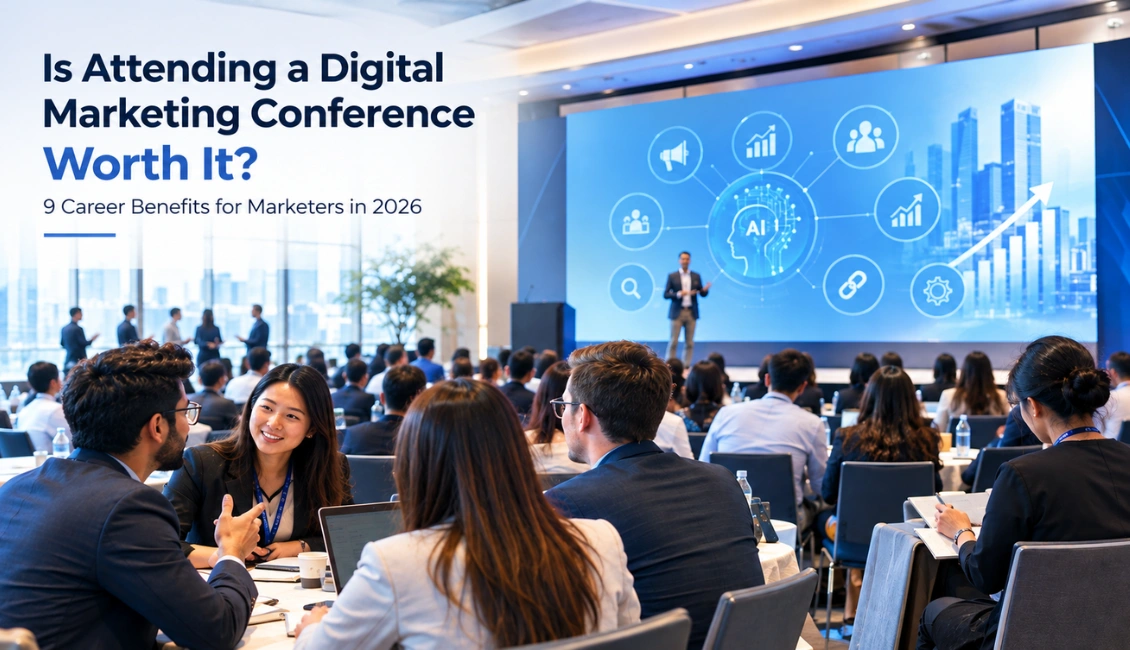
Why Attend a Digital Marketing Conference? 9 Career Benefits, Costs and ROI
Quick Answer
Yes, a digital marketing conference can be worth attending-but the value depends on what you want to achieve. The strongest returns usually come when the event matches your career goals, offers relevant sessions and gives you opportunities to learn, meet peers and turn ideas into action after the event.
Introduction
Marketing is changing quickly. Artificial intelligence, evolving search behaviour, retail media, automation and new measurement models are changing how marketers plan campaigns and interact with customers.
The scale of this change is reflected in advertising investment. Dentsu’s May 2026 forecast puts global advertising spend at approximately $1.06 trillion for 2026, with digital accounting for about 69% of total spend. The same forecast projects APAC advertising growth of 5.9% and highlights retail media, connected TV, video, social and other digitally driven channels as important areas of growth.
For marketers, keeping up is no longer simply about reading more articles or completing another online course. Industry events can provide a different type of learning: direct conversations with practitioners, exposure to different approaches and the opportunity to discuss problems with people working through similar challenges.
But conferences are not automatically valuable.
A poorly matched event can consume time and money without producing anything useful. This guide looks at both sides of the question: what marketers can gain from attending a digital marketing conference, how to measure the value, and when attending may not make sense.
Table of Contents
- What is a digital marketing conference?
- 9 career benefits of attending a digital marketing conference
- What attendees say
- Who benefits most, by career stage
- How much does a marketing conference cost?
- How to get the most out of a conference
- In-person vs. virtual vs. hybrid conferences
- When a conference may not be worth it
- How to choose the right conference in 2026–2027
- Key takeaways
- Conclusion
What Is a Digital Marketing Conference?
A digital marketing conference is a professional event where marketers, business leaders, technology providers, agencies, consultants and other industry professionals come together to exchange knowledge, discuss trends and build professional relationships.
Depending on the event, the programme may include keynote presentations, panel discussions, workshops, networking sessions, exhibitions, demonstrations and awards.
There are also different types of conferences. Some focus broadly on digital marketing, while others concentrate on subjects such as SEO, performance marketing, content, MarTech, advertising, e-commerce or AI in marketing.
The format can also vary. Some events are entirely in person, while others are virtual or hybrid.
The important distinction is not the size of the conference but its relevance to your work.
A smaller specialist event may provide more useful conversations for a particular marketer than a large general-purpose conference.
9 Career Benefits of Attending a Digital Marketing Conference
A conference can provide value beyond sitting through presentations. The real benefit often comes from combining learning, conversations and follow-up.
Here are nine ways attending the right event can support a marketing career.
1. Meet People Who Can Change Your Career
What you gain
Professional networking is one of the most obvious reasons people attend conferences, but effective networking is not simply collecting business cards or LinkedIn connections.
A useful conversation might introduce you to someone working in a role you are interested in, a marketer dealing with the same problem, a potential client, a future employer or a specialist whose expertise complements your own.
Conferences make these conversations easier because participants already have a shared professional context.
Evidence and example
Many conferences deliberately create networking opportunities through discussion sessions, roundtables, lunches, workshops and structured introductions.
For example, the 2026 DMAT Confex programme in Singapore includes dedicated networking breaks, a one-on-one introduction session, networking lunch and roundtable opportunities alongside its educational sessions.
How to use it
Instead of trying to meet as many people as possible, set a realistic target before attending.
You might aim to have five meaningful conversations with people connected to your current career goals.
After each conversation, write down one detail that will help you remember the person and why you connected.
The quality of the relationship matters more than the size of your contact list.
2. Learn Current Tactics From Practitioners
What you gain
Marketing changes faster than many formal training programmes can accommodate.
A conference can expose you to practical examples of how companies are currently approaching SEO, paid media, content, customer experience, analytics, automation and other areas.
The advantage is not necessarily that conference speakers know something nobody else knows. It is that they can explain how an idea works in an actual business environment.
Evidence and example
The current advertising environment illustrates why continuous learning matters. Dentsu’s 2026 forecast says digital advertising represents roughly 69% of global advertising investment and notes that search, retail media, social and video are evolving as marketers adapt to changing consumer behaviour.
How to use it
Do not try to remember every presentation.
Instead, choose two or three sessions connected to a problem you are currently solving.
For each session, ask:
- What is different from what we currently do?
- Is there evidence behind the approach?
- Could this work with our resources?
- What would I need to test it?
That turns conference learning into something practical.
3. Stay Ahead of AI, Search and Measurement Changes
What you gain
AI is affecting more than content generation.
Search behaviour, campaign optimisation, customer journeys, analytics, creative production and marketing operations are all being influenced by AI-based systems.
For marketers, the challenge is not simply learning about new tools. It is understanding how these technologies may change existing responsibilities.
Evidence and example
Dentsu’s 2026 forecast identifies algorithm-driven advertising as an increasingly important part of the media ecosystem and expects algorithmically enabled advertising to reach 75% of total ad spend by 2028. It also notes that search growth is evolving as AI, retail and social search increasingly compete with traditional search behaviour.
How to use it
When attending sessions about AI in marketing, avoid focusing only on tools.
Look for discussions about:
- Data and privacy
- Human oversight
- Measurement
- AI governance
- Workflow changes
- Search visibility
- Customer experience
- Skills marketers will need next
For a deeper introduction, marketers can also explore “What Is Agentic AI in Marketing? A 2026 Guide for Marketing Leaders” as a related resource.
The goal is to understand the business implications-not simply leave with a list of AI tools.
4. Build Hands-On Skills Through Workshops
What you gain
Presentations are useful for understanding ideas. Workshops can be more useful when you need to practise them.
A workshop might involve campaign planning, analytics, SEO, AI tools, content strategy, customer journey mapping or another practical marketing task.
The value comes from doing rather than only listening.
Evidence and example
Some modern marketing conferences are increasingly separating educational sessions from practical formats. For example, APAC Marketing Summit 2027 in Bengaluru lists a dedicated workshop day with multiple one-hour workshops as part of its three-day programme.
How to use it
Before attending a workshop, identify one real problem from your work that relates to the topic.
During the session, consider how the framework could be adapted to your situation.
Afterward, document:
Problem → Method learned → First experiment → Expected result
That gives you something concrete to test rather than another set of notes sitting in a folder.
5. Find Jobs, Clients and Partnerships
What you gain
Career opportunities do not always come from formal recruitment channels.
A conversation at a conference can lead to an interview, freelance project, consulting opportunity, referral or partnership.
This can be particularly relevant for freelancers, consultants and agency professionals, although employees can also benefit.
Evidence and example
Conference programmes often bring together people from different parts of the marketing ecosystem.
The current APAC Marketing Summit, for example, describes its audience as including in-house marketing teams, heads of growth and performance, fractional CMOs, agency founders and tool founders.
How to use it
Your introduction should not sound like a sales pitch.
Try something simple:
“I work mainly on B2B SEO and content strategy. Recently I’ve been looking at how AI search is changing discovery.”
This gives the other person something specific to respond to.
If there is a genuine professional fit, follow up after the event.
For freelancers and agencies, the same principle applies: start with relevance, not a sales presentation.
6. Build Your Personal Brand-and Your Path From Attendee to Speaker
What you gain
Conferences can also help marketers become more visible within their professional community.
You do not have to be a speaker to participate.
You can ask thoughtful questions, publish useful takeaways, contribute to discussions or share a practical observation from your own work.
Over time, these activities can help establish what you are knowledgeable about.
Evidence and example
Industry conferences increasingly feature practitioners from marketing, technology, customer experience, data and leadership roles rather than relying on a single professional discipline.
The 2026 DMAT Confex programme, for example, includes speakers from organisations such as GSK, Cigna Healthcare, ServiceNow, Tech Mahindra, Dell Technologies and Liferay, covering different areas of marketing and technology.
How to use it
Choose one topic you understand well.
During and after the event, publish something useful about it:
- Three lessons from a session
- A framework you found interesting
- A question raised during a panel
- An example of how a trend could affect marketers
If you consistently contribute useful ideas, conference participation can become part of a broader professional reputation.
7. Learn How Experienced Speakers Communicate
What you gain
A conference is also an opportunity to study communication.
Experienced speakers demonstrate how to explain complex subjects, structure presentations, tell stories, use examples and answer difficult questions.
These skills matter even if you never plan to become a keynote speaker.
Marketing managers regularly need to present strategies to executives, explain campaign results, defend budgets and persuade stakeholders.
Evidence and example
Most professional conferences combine different presentation formats, including keynotes, panels, presentations and interactive discussions.
That variety allows attendees to compare different communication styles rather than learning presentation techniques only from a textbook.
How to use it
During a strong presentation, pay attention to the structure.
Ask yourself:
- How did the speaker open?
- What problem did they establish?
- Which examples made the argument easier to understand?
- How did they use data?
- How did they finish?
You can then apply those techniques to your next presentation.
8. Benchmark Yourself Against Peers
What you gain
One underappreciated benefit of conferences is comparison.
Marketing professionals can become very focused on their own company, industry and performance metrics. A conference introduces different perspectives.
You may discover that a challenge you thought was unique to your company is common across the industry.
You may also discover that another organisation is approaching the same problem differently.
Evidence and example
Current marketing conferences cover topics across AI, performance marketing, customer experience, search, MarTech, advertising and measurement.
For example, the 2026 DMAT agenda includes discussions around agentic AI, AI-first discovery, hyper-personalisation, AI-native MarTech, retail media, measurement and AI governance.
How to use it
Create a simple benchmarking list:
| Question | Your organisation | What you heard |
|---|---|---|
| How are we using AI? | ||
| How do we measure performance? | ||
| What channels are growing? | ||
| Which skills are missing? | ||
| What are competitors testing? |
The purpose is not to copy another company.
It is to identify where your current approach may need to evolve.
9. Plan Your Next Career Move
What you gain
Sometimes the most valuable conference outcome is clarity.
You may attend thinking you need another technical skill and realise that your next step is actually management.
Or you may discover a new specialisation such as AI strategy, marketing analytics, customer experience or MarTech that fits your interests.
Evidence and example
Marketing roles are becoming increasingly connected to technology and data. Dentsu’s 2026 forecast highlights the growing role of algorithms and AI-related changes across media and advertising.
How to use it
After the conference, write down three answers:
What do I know now that I didn’t know before?
What skill do I need to strengthen?
What role or responsibility could I realistically move toward next?
A conference cannot make the career decision for you. But it can give you more information with which to make that decision.
What Attendees Say
Testimonials can provide useful context, but they should be treated as individual experiences rather than proof that every attendee will achieve the same result.
For example, testimonials published by DIGITALCONFEX include feedback from past speakers and attendees describing the value of industry conversations and professional connections. One past attendee, Santanu Bhattacharjee, Director of AI & Product Engineering at Pretium, shared that being part of the 4th IT Confex 2026 in Delhi was a privilege, highlighting its intimate closed-group format and meaningful, thought-provoking panel discussions.
Another testimonial from Swapnil Saurav, associated with DMAT Confex 2025 in Dubai, described the event as well-curated and noted its mix of industry leaders, practitioners and innovators.
These examples illustrate potential outcomes, but individual experiences vary. Any direct quotation should be republished only where the organiser has the necessary permission to use it.
Who Benefits Most, by Career Stage?
The value of a marketing conference can differ considerably depending on where you are in your career.
| Career stage | Main goal | What to prioritise | Typical outcome |
|---|---|---|---|
| Students & freshers | Understand the industry | Career sessions, networking, practical introductions | Better understanding of marketing roles |
| Specialists | Develop expertise | Workshops, technical sessions, peer discussions | New methods to test at work |
| Managers & CMOs | Strategy and leadership | Executive sessions, benchmarking, emerging trends | New perspectives for planning |
| Freelancers | Build relationships | Networking, niche sessions, client conversations | Potential leads and collaborations |
| Agency owners | Growth and partnerships | Market trends, decision-makers, partnerships | New business conversations |
The key is to attend with a career-stage-specific objective.
A student does not need the same conference experience as a CMO, just as an agency owner may prioritise different sessions from an SEO specialist.
How Much Does a Marketing Conference Cost, and How Do You Justify It?
Conference costs vary considerably. The ticket is only one part of the total expense.
You may need to consider:
- Registration
- Flights or local transport
- Accommodation
- Meals outside the event
- Time away from work
- Opportunity cost
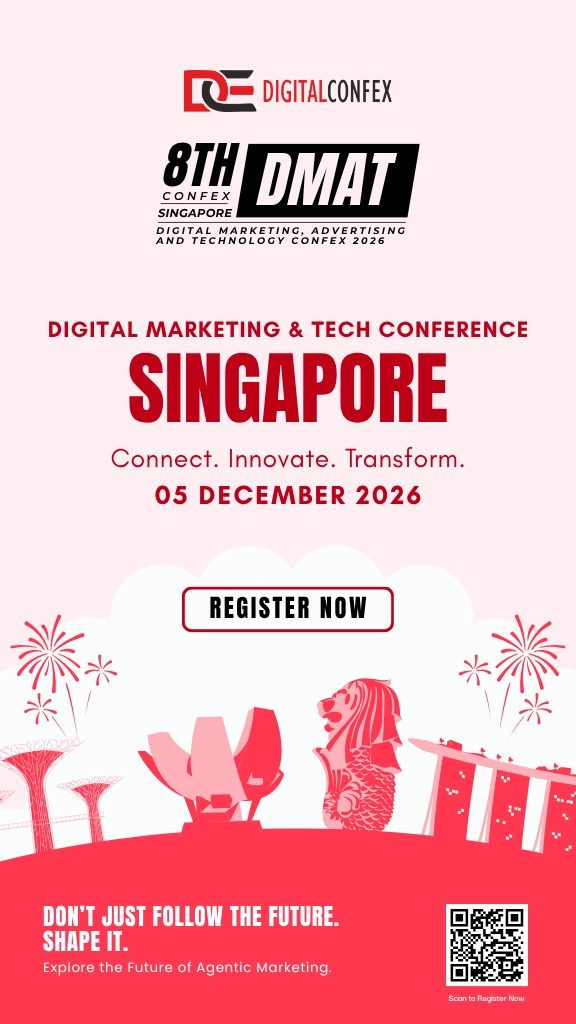
For example, as of September 2026, the 8th DMAT Confex in Singapore offers a Basic Pass at US$199 until September 30, compared with the regular price of US$299. This gives attendees an opportunity to access the conference at a lower early-bird rate while planning ahead.
By comparison, the APAC Marketing Summit 2027 in Bengaluru lists its early-bird Summit ticket at ₹10,700, increasing to ₹15,700 after October 30, 2026, alongside lower-cost Expo access.
These examples highlight that DMAT Confex offers a competitive entry point for professionals looking to attend a focused marketing, advertising and technology conference in Singapore. However, the ticket price is only one part of the overall cost—travel, accommodation and other expenses should also be considered when comparing international conferences.
Ways to reduce the cost
Consider:
- Early-bird registration
- Group or corporate rates
- Virtual attendance
- Employer sponsorship
- Speaking opportunities
- Volunteering, where available
- Local conferences that reduce travel expenses
How to justify the cost to your manager
Keep the business case simple.
1. State the goal
“I want to attend to learn about AI-driven search and measurement.”
2. Define the expected outcome
“I will identify three approaches relevant to our current marketing programme.”
3. Explain how the learning will be shared
“I will present the key takeaways to the team and create a 30-day testing plan.”
That makes the request about a business outcome rather than simply attending an event.
How to Get the Most Out of a Conference
The value of a conference depends heavily on what happens before and after the event.
Before the Conference
Set three specific goals.
For example:
- Learn about AI search
- Meet five relevant professionals
- Find one practical idea to test
Review the agenda beforehand and shortlist sessions that directly relate to those goals.
If there are speakers or attendees you would genuinely like to meet, consider connecting with them before the event.
It also helps to update your LinkedIn profile so that people you meet can quickly understand what you do.
During the Conference
Do not feel pressure to attend every session.
Choose sessions according to your objectives.
Take notes in a way that makes them useful later:
Idea → Why it matters → Where it could apply → Next action
When networking, record a short context note after the conversation.
Instead of writing:
“Met Rahul.”
Write:
“Rahul — B2B growth marketer. Discussed AI search measurement. Follow up about benchmark examples.”
That small detail can make follow-up much easier.
After the Conference
The follow-up is where much of the practical value is created.
Within 48 hours:
- Connect with relevant people
- Thank people who gave you useful advice
- Share one or two useful takeaways
- Organise your notes
- Identify ideas worth testing
Then create a simple 30-day action list.
| Time | Action |
|---|---|
| Day 1–2 | Organise notes and contacts |
| Week 1 | Share key insights with your team |
| Week 2 | Select one idea to test |
| Week 3 | Review early results |
| Week 4 | Decide whether to continue, change or stop |
The goal is not to implement everything you learned.
It is to turn one or two useful ideas into measurable action.
In-Person vs. Virtual vs. Hybrid Conferences
There is no universally superior format. The right choice depends on your priorities.
| Factor | In-person | Virtual | Hybrid |
|---|---|---|---|
| Networking | Usually easier for spontaneous conversations | More structured | Depends on event design |
| Cost | Usually higher | Usually lower | Moderate to high |
| Flexibility | Lower | Higher | High |
| Travel required | Travel required | No | Optional |
| Hands-on interaction | Hands-on interaction | Depends on platform | Varies |
| Content access | Often live | Often easier to revisit | Depends on event |
If networking is your primary goal, physical attendance may provide more opportunities for informal conversations.
If cost, accessibility or schedule flexibility is more important, a virtual option may make more sense.
When a Conference May Not Be Worth It
A marketing conference may not be the right choice if:
- The agenda doesn’t match your goals.
- Sessions are too basic or too broad.
- It feels more sales-focused than educational.
- The audience isn’t relevant to you.
- You’re unsure what you want to gain.
- Travel and accommodation costs are too high.
Quick Checklist
Before registering, ask:
- Is the agenda relevant to my work?
- Will I learn something useful?
- Will I meet relevant people?
- Does the format suit me?
- What will I do differently after attending?
If most answers are unclear, another event may be a better fit.
How to Choose the Right Conference in 2026–2027
The number of marketing events continues to grow, so choosing one should start with your objective rather than the event’s popularity.
Look at:
- Topic relevance
- Speaker background
- Audience profile
- Session format
- Networking opportunities
- Workshop availability
- Location and total cost
- Past attendee feedback
- Access to post-event resources
For marketers researching events in Asia, regional conference directories and specialist lists can help narrow the options.
For example, DIGITALCONFEX publishes information about marketing conferences in Asia, while its 2027 conference coverage provides a broader view of global and APAC events.
The 8th DMAT Confex 2026 in Singapore is one example of a conference focused on digital marketing, advertising and technology, with sessions covering areas such as AI, search, MarTech, advertising and customer experience.
The important question is not whether an event is widely promoted.
It is whether the event’s content and audience match your reason for attending.
Key Takeaways
- A digital marketing conference can be valuable when it matches a clear professional goal.
- Networking works better when the focus is on relevant conversations rather than collecting contacts.
- Conferences can help marketers understand changing areas such as AI, search, MarTech and measurement.
- Workshops and practical sessions can make learning easier to apply.
- The real return often comes from what you do after the event.
- If the agenda, audience or cost does not fit your needs, skipping the conference can be a reasonable decision.
Conclusion
Attending a digital marketing conference can be worthwhile when there is a clear reason behind the decision.
The strongest value often comes from a combination of learning, relevant conversations, professional benchmarking and practical follow-up. But conferences are an investment of both money and time, so choosing the right event matters.
Before registering, ask a simple question: What do I want to know, who do I want to meet, and what will I do differently afterward?
If you can answer those questions clearly, you are much more likely to get meaningful value from the experience.
Sources
- Dentsu. (2026). Ad Spend Growth Is Projected to Slow to 5.0% in 2026, Still Outpacing Economic Growth. Dentsu Global Ad Spend Forecasts
- DIGITALCONFEX. (2026). 8th Digital Marketing, Advertising & Technology Conference. DMAT Confex 2026 event information
- APAC Marketing Summit. (2026). APAC Marketing Summit 2027. APAC Marketing Summit 2027
- DIGITALCONFEX. Marketing Conference Asia 2026 resources. Marketing Conference Asia 2026
It can be, particularly when the conference aligns with your current career goals. The value may come from learning, networking, benchmarking, skills development or career exploration. However, the return depends on the event, your preparation and what you do with the information and connections afterward.
There is no standard price. Entry-level or expo passes may cost relatively little, while premium conferences can cost hundreds or more. International events also require travel and accommodation. Compare the total cost—not just the registration fee—before deciding whether an event fits your budget.
Frame the request around business value. Explain what you want to learn, which current business problem it relates to and how you will share the knowledge afterward. A short proposal with the conference cost, expected outcomes and a post-event action plan is usually more useful than simply asking for approval.
They can be, particularly for structured learning and lower-cost access. In-person conferences generally make spontaneous networking and face-to-face conversations easier, while virtual events offer greater flexibility. The better format depends on whether your primary objective is learning, networking, accessibility or cost control.
Start with the shared context. Ask someone what brought them to the conference or which session they found useful. You do not need to have a long conversation with everyone. A few relevant discussions are more useful than trying to meet a large number of people.
Review your notes, reconnect with useful contacts and identify one or two ideas worth testing. Share relevant insights with your team and create a short action plan. Follow-up is important because simply attending sessions does not guarantee that the information will influence your work.
There is no single conference that suits every marketer. Compare events based on your role, career stage, specialist interests, location, budget, agenda and audience. A marketer interested in AI and MarTech may need a different event from someone focused on SEO, performance marketing, content or customer experience.
- Affiliate Marketing
- AI in Marketing
- Artificial Intelligence
- Digital Marketing
- Digital Marketing Career
- digital marketing conference
- Digital Marketing Events
- digital marketing summit
- marketing conference asia 2026
- Marketing Conferences 2026
- Marketing Conferences 2027
- marketing events
- Marketing Tips
- Marketing Trends
- tech events