The Marketing World Has Changed Forever
Here is a number that should stop every digital marketer in their tracks: in 2026, more than 60% of search queries end without a single click. The user asked a question. According to multiple industry analyses, zero-click searches now account for more than half of all Google queries globally, reinforcing the shift from ranking-based visibility to AI-mediated discovery.
An AI answered it. Nobody visited your website. Traditional SEO in the age of artificial intelligence is no longer simply about earning the top position on a search results page – it is about becoming the trusted source that an AI chooses to cite, summarise, and surface within its generated answer.
This is not a slow evolution. It is a structural disruption. Google AI Overviews, Microsoft Copilot, Perplexity, and ChatGPT Search have collectively changed the way hundreds of millions of people discover information, compare products, and make decisions. For brands and marketers in Malaysia and across APAC, the question is no longer “How do we rank higher?” – it is “How does an AI learn to trust us?”
The answer lies in a concept that is rapidly defining the new frontier of marketing strategy: Hyper-Intelligence. It is the operating paradigm that separates the brands achieving compounding growth in 2026 from those watching their organic traffic erode, their ad efficiency plateau, and their competitive relevance diminish.
The shift is not from good SEO to great SEO. It is from human-directed marketing optimisation to AI-driven digital optimisation that operates continuously, autonomously, and with far greater precision than any manual process.
This article defines what Hyper-Intelligence is, how it is reshaping AI-first search visibility, and what Malaysian and APAC businesses must do right now to compete in this new reality.
AI SEO is becoming the foundation of modern digital marketing strategies, helping brands optimize content for AI search engines and generative discovery platforms.
Hyper-Intelligence in 60 Seconds
If you only remember four things from this article, remember this:
- Over 60% of searches now end without a click, as AI systems answer queries directly.
- Hyper-Intelligence is the convergence of agentic AI, predictive analytics, autonomous decision-making, and semantic understanding.
- The new search ecosystem operates across SEO, GEO, AEO, and AI-integrated discovery.
- Brands that optimise for AI citation and retrieval, not just rankings, will dominate digital visibility in 2026.
Hyper-Intelligence is not about using AI tools.
It is about redesigning your marketing operating model for an AI-first environment.
Defining Hyper-Intelligence in Digital Marketing
Before we define what Hyper-Intelligence is, it is important to be precise about what it is not – because the term is already being misused in ways that dilute its meaning and mislead marketers.
What Hyper-Intelligence Is NOT
- It is not using ChatGPT or Gemini to generate blog posts
- It is not running automated email sequences
- It is not A/B testing with an AI recommendation tool
Each of the above is a component of an AI-enabled marketing workflow. None of them, individually or collectively, constitutes Hyper-Intelligence.
The Formal Definition
Hyper-Intelligence in digital marketing is the convergence of agentic AI, predictive analytics, autonomous decision-making, and semantic understanding, operating simultaneously across all marketing channels to perceive intent, optimise performance, and generate value – continuously and without requiring constant human instruction.
This definition has four critical components, all of which must be present:
- Agentic AI marketing: AI systems that do not just respond to prompts but proactively execute tasks, set sub-goals, and adapt strategies based on real-time outcomes.
- Predictive analytics marketing: Using historical data, behavioural signals, and machine learning models to forecast outcomes before they happen – enabling proactive rather than reactive decisions.
- Autonomous decision-making: AI systems that can allocate budget, adjust messaging, shift targeting, and modify content without waiting for human approval at every step.
- Semantic understanding: The capacity to comprehend not just keywords but the intent, context, emotion, and entity relationships behind them – powering both content creation and search visibility.
The Three Operational Layers
A hyper-intelligent marketing system functions across three layers, all working in parallel:
- PERCEIVE AI continuously reads signals humans miss: micro-intent patterns, cross-channel behaviour shifts, emerging keyword clusters, competitor content movements, and audience sentiment changes.
- DECIDE AI makes real-time micro-decisions: which content to promote, which audience segment to target, which keywords to prioritise, which channels to increase investment in — based on live data rather than last month’s report.
- OPTIMIZE AI continuously improves its own outputs. Every impression, click, conversion, and bounce becomes a training signal that refines future decisions. The system grows more effective over time without manual recalibration. This is the foundation of genuine machine learning SEO and AI-powered SEO frameworks.
The Five Pillars of Hyper-Intelligent Digital Marketing
Understanding Hyper-Intelligence at a conceptual level is the starting point. Understanding its five operational pillars is where strategy becomes executable.
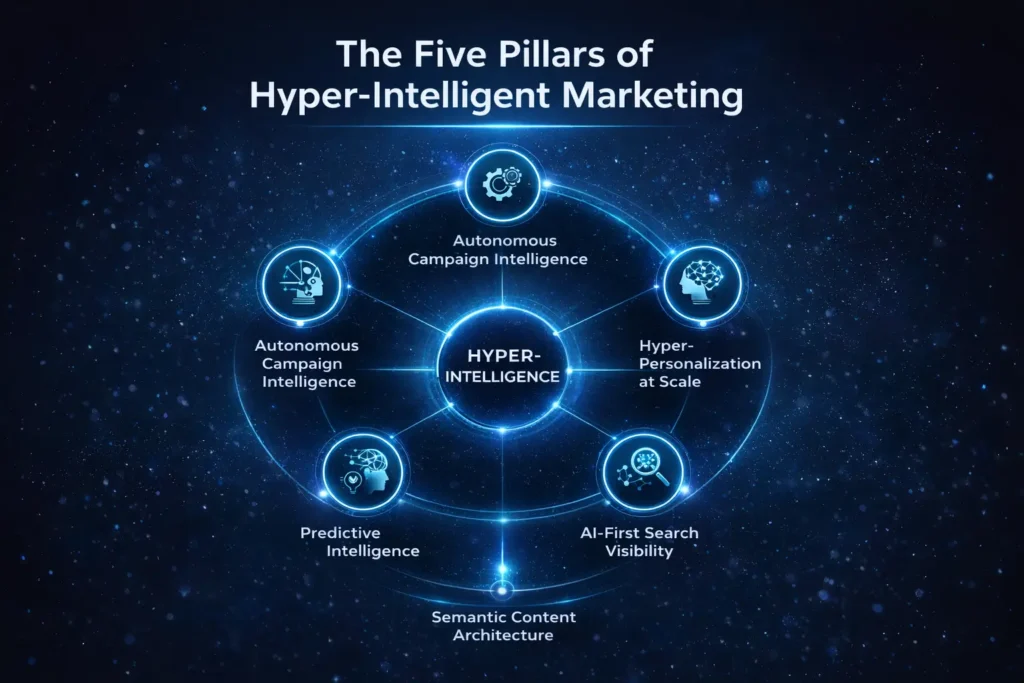
Pillar 1: Autonomous Campaign Intelligence
Traditional campaign management operates on a cycle: plan, launch, monitor, adjust. The interval between monitoring and adjustment can be days or weeks.
In a hyper-intelligent system, this cycle compresses to real-time. AI agents continuously assess campaign performance – not at the level of daily reports, but at the level of individual impression opportunities – and make autonomous micro-adjustments.
In practice, this means:
- Ad spend is reallocated mid-campaign based on live conversion signals, not end-of-week performance reviews
- Creative variants are tested and retired autonomously based on engagement velocity, not human-defined test durations
- Audience targeting parameters shift dynamically as new high-intent segments emerge
- Budget is moved between platforms (search, social, display, native) without requiring manual authorisation
The result is a campaign that never stops improving. AI marketing automation at this level is not about removing human creativity – it is about removing human bottlenecks from execution decisions that can and should happen faster than any human can manage.
Pillar 2: Hyper-Personalization at Scale
Mass marketing is dead. Segmented marketing is declining. The standard in 2026 is genuine 1-to-1 communication delivered at enterprise scale – which is only possible through AI.
Hyper-personalization means a consumer’s experience of your brand is shaped by:
- Their real-time browsing intent and search behaviour
- Their purchase history and predicted next purchase
- Their location, device, time of day, and current context
- Their emotional disposition as inferred from content engagement patterns
In the Malaysian context, where consumers shift fluidly between platforms – from TikTok to Google to WhatsApp to Lazada – within a single purchase journey, hyper-personalization at scale requires an AI layer that unifies these signals and delivers a coherent, contextually relevant brand experience at each touchpoint. This is not a luxury feature for global brands. It is a practical requirement for any enterprise competing in digital markets in 2026.
Pillar 3: AI-First Search Visibility (SEO → GEO → AEO)
This is the pillar that most directly disrupts the traditional SEO playbook, and it is the one that requires the most immediate strategic recalibration.
The evolution of search has moved through three phases in rapid succession:
- Traditional SEO: Optimise for human users reading a ranked list of blue links. Earn position #1.
- Generative Engine Optimization (GEO): Optimise for AI systems that generate synthesised answers. Earn citation within the generated response.
- Answer Engine Optimization (AEO): Optimise specifically for answer-format queries processed by conversational AI. Become the definitive, citable source for a topic.
In 2026, all three phases are simultaneously active – but the growth in traffic and brand authority is concentrated in GEO and AEO. AI Overviews SEO has introduced an entirely new category of brand touchpoint: a user may encounter your brand exclusively within Google’s AI-generated answer, never having visited your website. This makes the zero-click search optimization challenge both a threat and an opportunity.
The threat: users may get what they need without visiting your site. The opportunity: if your brand is the one cited by the AI, you have earned a high-authority brand impression at the most trusted position in the new search landscape – above all traditional results.
Achieving AI-first search visibility requires structured content, strong E-E-A-T signals, topical authority across semantically related content clusters, and technical optimisation that makes your content machine-readable – not just human-friendly.
Pillar 4: Predictive Intelligence & Behavioural Forecasting
Most marketing organisations are still operating reactively: analysing what happened last month and adjusting strategy accordingly. Predictive analytics marketing inverts this model entirely.
A hyper-intelligent marketing system uses ML models to:
- Forecast which customer segments are most likely to convert in the next 30 days
- Predict churn risk before it manifests in cancelled subscriptions or reduced engagement
- Identify the optimal time, channel, and message for each individual prospect
- Model campaign ROI before launch, enabling smarter pre-launch investment decisions
- Detect emerging search intent trends weeks before they appear in keyword volume data
The strategic implication is profound: marketers who operate with predictive intelligence are not competing on the same terms as those who operate reactively. They are playing a different game — one where they respond to future demand rather than past signals.
Pillar 5: Semantic Content Architecture
The fifth pillar is the one that most directly connects to semantic search optimization – and it is frequently the most misunderstood. Semantic content architecture is not about writing longer articles. It is about structuring your entire content ecosystem so that AI systems can accurately understand what you know, who you are, and why you should be trusted.
This requires three levels of attention:
- Topical Authority: Comprehensive coverage of a subject domain through interconnected content clusters, not isolated pages. AI systems assess the breadth and depth of your expertise across a topic — not just the quality of a single page.
- E-E-A-T Optimization 2026: Experience, Expertise, Authority, and Trustworthiness signals are now processed by AI systems as well as human reviewers. Author credentials, cited sources, original research, and consistent factual accuracy all contribute to your E-E-A-T profile.
- Structured Data & Machine Understanding: Schema markup, entity disambiguation, and natural language patterns that make your content interpretable by AI models — not just indexable by crawlers. In an era of RAG (Retrieval-Augmented Generation) SEO, structured data determines whether your content becomes part of an AI’s knowledge base or remains invisible to it.
AI SEO: The Foundation of Hyper-Intelligent Digital Marketing
As search engines evolve into AI-powered discovery platforms, traditional SEO strategies alone are no longer sufficient. AI SEO focuses on optimizing content so that artificial intelligence systems can retrieve, understand, and cite it within generated responses.
AI SEO strategies include:
- semantic content architecture
- structured data implementation
- topical authority building
- generative engine optimization (GEO)
- answer engine optimization (AEO)
Organizations that implement AI SEO frameworks are far more likely to appear in AI-generated answers, voice searches, and conversational search interfaces.
How Hyper-Intelligence Is Reshaping SEO in 2026
The search landscape in 2026 is not one channel – it is a four-layer universe that every brand with an online presence must navigate simultaneously. AI-driven digital optimization now requires strategies that work across all four layers at once:
- Traditional SEO: Organic ranking for users who still click through to websites
- AIO (AI-Integrated Optimization): Appearing within AI-generated summaries in Google and Bing
- GEO (Generative Engine Optimization): Being cited as a source in generative AI responses across platforms
- AEO (Answer Engine Optimization): Being the definitive answer for conversational and voice queries
The technical mechanism connecting GEO and AEO deserves specific attention: RAG (Retrieval-Augmented Generation). When an AI model generates a response to a user query, it does not invent information – it retrieves relevant content from indexed sources and synthesises it. The brands whose content is retrieved most reliably are those with the strongest combination of topical authority, structural clarity, and trust signals.
In practical terms: if your website is not optimised to be retrieved by RAG systems, you are invisible to the fastest-growing discovery channels in digital marketing today.
The Malaysian and APAC Opportunity
For Malaysian businesses and APAC enterprises, the AI search transition represents a genuine competitive window that will not remain open indefinitely. AI search visibility Malaysia is still in an early-adoption phase – many local competitors have not yet restructured their content for GEO or AEO. This means that brands which act decisively now can capture AI-cited positions before these become as competitive as traditional page-one rankings.
The multilingual dimension of the Malaysian market – where consumers search in English, Bahasa Malaysia, and Mandarin, often switching between languages within the same session – creates a unique digital transformation Malaysia opportunity. AI search systems are rapidly improving at multilingual intent recognition, which means that brands with well-structured, multilingual content architectures can achieve AI citation reach that their monolingual competitors cannot match.
Hyper-Intelligence in Practice: Real-World Applications
Hyper-Intelligence is not a theoretical framework reserved for multinational technology companies. It is being operationalized across industries in Malaysia and APAC today. Here are four concrete examples:
E-Commerce Malaysia
A mid-sized Malaysian e-commerce retailer implements an AI-first content strategy built around predictive product demand. The AI layer analyses search trend data, social signals, and purchase history to surface which product categories are gaining intent momentum 3-6 weeks before peak demand. Content is created, optimised, and distributed to capture this demand at the point of emergence — not after competitors have already flooded the space. The result: consistently early-mover advantage in high-converting seasonal and trend-driven categories.
B2B Enterprise Marketing
A B2B technology firm replaces its lead nurturing sequence with an agentic AI system. Rather than a fixed email cadence, the AI observes each prospect’s engagement behaviour in real-time and adjusts message timing, content, and channel selection individually. A prospect who reads three technical whitepapers on a Tuesday receives a tailored case study and a direct connection request on LinkedIn within 24 hours. This is AI marketing automation at the level of genuine personalisation – not just segmentation.
What Hyper-Intelligence Demands from Marketers
Let us be direct about something that often gets obscured in AI enthusiasm: Hyper-Intelligence does not replace skilled marketers. It redefines what skilled marketing looks like.
The most effective marketing professionals in 2026 are not those who have been replaced by AI — they are those who have evolved their role to become the strategic intelligence layer above the AI. This requires a fundamentally new skill set:
- Prompt Engineering & AI Direction: The ability to communicate precisely with AI systems to produce the strategic and creative outputs that serve business goals — not just generic content.
- Data Literacy: Understanding what AI-generated insights mean, where they may be wrong, and how to act on them with business context that the AI does not have.
- AI Output Evaluation: Critically assessing AI-generated content, strategies, and optimisations for accuracy, brand alignment, and strategic coherence. AI systems produce plausible-sounding outputs that are not always correct.
- Enterprise SEO Training: Deep knowledge of AI-powered SEO frameworks, semantic architecture, GEO, AEO, and the technical requirements of AI citation — which are substantially different from traditional SEO competencies.
- Ethical AI Governance: Understanding where autonomous AI decisions require human oversight — particularly in areas like personalisation (privacy implications) and content at scale (accuracy and brand reputation risks).
The professionals who invest now in future-ready SEO strategies and AI-first marketing competencies will not just survive the current transition — they will become the indispensable architects of the next generation of marketing excellence.
Human creativity, ethical judgment, emotional intelligence, and strategic vision remain irreplaceable. Hyper-Intelligence amplifies these qualities — it does not make them redundant.
Why Malaysia and APAC Are at the Epicentre of This Shift
While much of the AI marketing narrative is framed around Silicon Valley and Europe, some of the most significant competitive shifts are unfolding across Malaysia and Southeast Asia. The region’s digital infrastructure, consumer behaviour, and market dynamics make it uniquely positioned for rapid AI-first transformation.
- Mobile-First Behaviour
Southeast Asia is one of the most mobile-native regions globally. AI-powered search, voice queries, and conversational commerce are already embedded in everyday consumer journeys. This accelerates the impact of AI-first search visibility strategies. - Multilingual Search Complexity
Malaysia’s multilingual environment creates both complexity and opportunity. Consumers frequently switch between English, Bahasa Malaysia, and Mandarin within a single research journey. Brands with structured, multilingual content architectures are better positioned for AI citation and retrieval across diverse intent signals. - High-Growth Digital Economy
Malaysia’s expanding e-commerce and digital services ecosystem increases competition for visibility. As AI systems increasingly mediate discovery, businesses that adopt AI-driven digital optimization early gain disproportionate advantage. - Early-Mover Advantage
AI-first search strategies, including multilingual GEO and structured content optimization, are still underutilised by many regional enterprises. Brands that act now can secure AI citation positions before competition intensifies.
As AI reshapes digital discovery across APAC, the competitive window for structured, AI-ready marketing strategies is open – but narrowing.
How to Build a Hyper-Intelligent Marketing Strategy: A 5-Step Framework
Strategy without structure is aspiration. Here is a practical framework for operationalizing Hyper-Intelligence in your organization — regardless of your current starting point.
| Step | Action | What This Means in Practice |
| 01 | AUDIT | Map every touchpoint where AI currently intersects with your marketing: search visibility, content performance in AI systems, campaign automation tools, and data infrastructure. Identify gaps between your current capabilities and a hyper-intelligent operating model. |
| 02 | STRUCTURE | Rebuild your content architecture for semantic search optimization. This means organising content into topical authority clusters, implementing structured data comprehensively, establishing clear E-E-A-T signals, and ensuring your site is technically optimised for AI retrieval (not just human readability). |
| 03 | INTEGRATE | Connect your SEO, GEO, and AEO strategies into a unified AI-first search visibility approach. This is not three separate workstreams — it is one coherent strategy for being found across all surfaces where your customers discover information, using consistent AI-powered SEO frameworks. |
| 04 | AUTOMATE | Identify which marketing decisions can be delegated to autonomous AI systems: bid management, content personalisation, audience targeting, and performance reporting. Implement AI marketing automation in these areas systematically, maintaining human oversight for brand, ethics, and high-stakes decisions. |
| 05 | MEASURE | Redefine your KPIs for the AI era. Add: AI citation frequency (how often your brand appears in AI-generated answers), share-of-voice in generative results, semantic authority scores, and RAG retrieval frequency. These new metrics reflect the AI-first content strategy outcomes that traditional analytics do not capture. |