The 2026 Marketing Reality Check
It’s Monday morning. Your boss wants you to create five different campaigns, look at data from three platforms, and write a strategy document. All before lunch. Two years ago, you’d need a team and a full week for this. Now? You’re supposed to finish it alone by 5 PM.
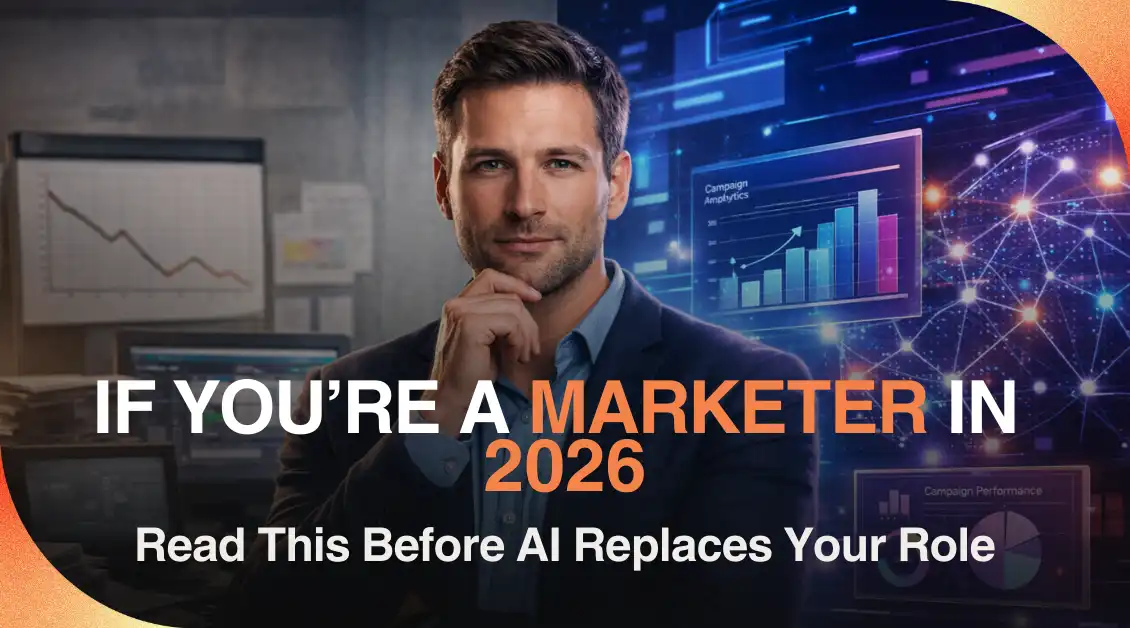
This is marketing in 2026. AI tools aren’t optional anymore-they’re everywhere. Teams that had twelve people now have six. The main difference between marketers who are thriving and those who are struggling comes down to one thing: are you using AI, or fighting it?
The worry is real. From 2024 to early 2025, marketing teams got smaller. Companies said the same thing: “AI helps us do more with fewer people.” News articles made everyone nervous.
Social media was full of posts saying marketing jobs were dying. New marketers wondered if they’d chosen the wrong career. Experienced marketers questioned if their skills still mattered.
But here’s what got missed in all that noise: those marketers who left weren’t replaced by robots. They were replaced by other marketers who learned how to get better results using AI.
The real question isn’t whether AI will change marketing-it already has. The question is whether it’s making marketers obsolete or making them better. And honestly? That depends on you.
Why This Fear Exists
AI marketing tools are everywhere now. In 2023, people were just testing them out. By 2026, they’re part of everyday work. Tools for writing content, analyzing data, running ads, making designs, personalizing messages-the list keeps growing.
Numbers tell the story: more than 80% of marketers now use AI tools every day. That’s up from less than 30% in early 2023. The time it takes to finish campaigns has dropped by 60-70% in companies using AI. But here’s the problem: bosses now expect each marketer to do 90% more work. You’re not just supposed to be faster-you’re supposed to deliver way more results with the extra time AI gives you.
Companies started by cutting jobs that involved a lot of repetitive work. People who scheduled social media posts manually. Writers who wrote basic blog articles. Analysts who made the same reports every week. Campaign managers who adjusted ads one keyword at a time. These weren’t bad at their jobs—they were just doing things AI could copy.
This isn’t the first time marketing has changed like this. In the 2010s, automation tools eliminated manual email work. Social media changed how brands talked to customers. Programmatic ads removed human media buyers. Each time, people panicked. Each time, new and better jobs showed up for marketers who learned the new way. What’s different now is how fast it’s happening and how much is changing at once.
What AI Is Actually Replacing
Let me show you what’s actually changed:
Before AI (Pre-2023):
– Marketers spent almost half their time on reports, copying data from different platforms into spreadsheets
– Fixing campaigns meant logging into five different ad accounts and changing settings based on yesterday’s numbers
– Writing content meant starting with a blank page, spending hours on each piece, and going through multiple rewrites
– Teams were split up by channel: one person for email, another for social media, another for search ads
– Launching anything new took months because every single piece needed someone’s full attention
After AI (2026):
– Reports happen automatically—you just ask a question and get the answer with context
– Campaigns adjust themselves continuously, testing thousands of options at once
– Content drafts appear in minutes, so marketers can focus on making them better and on-brand
– Teams are smaller but smarter, with marketers managing AI across multiple channels instead of doing everything manually
– Launches happen in weeks instead of months because AI handles the production work while people focus on strategy
See what’s getting replaced? Repetitive work. Copying and pasting data. Following templates. Busy work that doesn’t require thinking. What’s not getting replaced? Being responsible for results. Making decisions. Understanding why something matters. Knowing what the business actually needs.
AI takes over tasks. It doesn’t take over the marketer who knows which tasks actually matter.
What AI Cannot Replace
Two companies in the same industry can use the exact same AI tools and get completely different results. The tool isn’t what makes the difference-it’s the person using it.
AI doesn’t understand context unless you explain everything. It doesn’t know your CEO hates a certain color because a product failed three years ago. It doesn’t understand that your customers are traditional and won’t like edgy messaging, even if that style tests well elsewhere. It can’t tell when a cultural moment makes your planned campaign feel wrong.
Strategy still needs human thinking. AI can create ten campaign ideas based on past data. But it can’t tell you which one fits where your brand needs to go in three years. It can’t factor in the competitive issues your sales team deals with every day. It can’t sense that your market is about to change in ways that aren’t showing up in the data yet.
Brand voice is hard for AI to copy. AI creates things that usually perform okay. But “usually okay” makes everything look the same. Every AI trained on the internet comes up with similar ideas. Without a human who really understands the brand, competitive position, and culture, AI marketing all starts to blend together.
Human judgment matters most when it really counts. During a crisis, AI can write response options, but it can’t decide which tone will keep trust versus which will make things worse. During a big product launch, AI can figure out the best media mix, but it can’t decide whether to lead with inspiration or education. When repositioning a brand, AI can study competitor messages, but it can’t weigh all the small factors that make a brand feel right.
This is why two marketers using the same AI tool get totally different results. One treats AI like it’s making the decisions and becomes someone who just clicks buttons. The other uses AI to do more and becomes someone the company can’t replace.
Real-Life Role Comparison: Marketer A vs Marketer B
Marketer A (Avoiding AI):
Sarah has been in B2B marketing for fifteen years. When her company brought in AI tools in 2024, she didn’t want to use them. “I’ve always done great work without these shortcuts,” she thought. She still builds campaign reports manually, spending hours each week copying data from different platforms into spreadsheets. She writes every piece of content from zero because “AI can’t get our voice right.” She checks campaigns once a week and makes changes based on her gut feeling.
By 2026, Sarah is struggling. She’s not producing more than before, but everyone expects her to. Her coworkers who use AI finish five campaigns in the time it takes her to finish one. Her bosses are asking why simple tasks take her so long when others finish them in hours. She feels attacked and alone. Her years of experience feel like they’re working against her instead of for her.
Marketer B (Working with AI):
Marcus has seven years in marketing. When AI tools came around, he was curious but careful. He started small: using AI to write first drafts, then editing heavily to match the brand. Using AI to pull together reports, then double-checking the analysis made sense. Using AI to create campaign options, then using his judgment to pick which ones fit the business goals.
By 2026, Marcus is doing really well. He runs three times as many campaigns as before, but he’s not working crazy hours—he’s just working smarter. AI handles the production and number-crunching. Marcus focuses on strategy, positioning, and the decisions that need human thinking. His bosses see him as someone who makes the whole team better. His career is moving faster because he can now do in weeks what used to take months.
The Real Difference:
It’s not about how old you are or how long you’ve been working. It’s about treating AI as something that helps you instead of threatens you. Sarah knows her stuff, but she’s spending time on work that doesn’t add value anymore. Marcus knows his stuff too, but he’s using it on decisions where human judgment actually matters.
How much they get done: Marcus delivers three times more in the same time.
Career growth: Marcus is being prepared for bigger leadership roles; Sarah is fighting to prove she’s still relevant.
How they’re seen: Marcus looks like an innovator; Sarah looks like someone stuck in the past.
Skills Shift: 2023 vs 2026
Skills That Matter Less Now:
– Knowing just one platform really well: Being an expert at Facebook Ads or Google Analytics isn’t special anymore. AI handles most of the platform work.
– Being fast at manual work: Being quick at building emails, making social posts, or creating reports doesn’t help when AI does it in seconds.
– Creating basic content: Writing blog posts that sound like everyone else’s, making ads from templates—AI does this without needing human help.
– Only knowing one channel: Being “the email person” or “the social media person” limits you when marketers need to work across everything.
Skills That Matter More Now:
– Strategic thinking with AI: Knowing what to ask AI, understanding its answers, and deciding what to actually use requires thinking that makes AI way more powerful.
– Knowing how to direct AI: Being able to frame problems clearly and get good results from AI is becoming a must-have skill.
– Understanding what insights actually mean: AI shows you patterns and connections. People need to figure out which ones actually matter and which are just random noise.
– Making decisions across channels: Running campaigns on multiple platforms, balancing trade-offs, and focusing on business results instead of just channel numbers.
– Using AI responsibly: Understanding when AI might be biased, privacy issues, and brand risks. Knowing when to ignore what AI suggests.
– Telling stories with data: Turning numbers into stories that help the business make decisions.
– Understanding context: Applying business knowledge, market dynamics, and brand understanding that AI doesn’t have.
The pattern is obvious: doing things gets automated, making decisions gets more important. If your value is about doing tasks, you’re competing with software. If your value is about deciding what matters, you’re essential.
Common Questions Marketers Are Asking
Will AI replace marketing jobs?
Some jobs, yes. Not because AI can do everything marketers do, but because AI shows which jobs were built around tasks instead of results. If your job is basically a list of steps you repeat without really making decisions, that job is at risk. But companies need strategic marketers who can drive real business results more than ever.
Which roles are most at risk?
Jobs that are all about execution in content writing, basic campaign management, simple data analysis, and manual reporting. Jobs held by people who refuse to learn new tools-no matter what their title is. Entry-level jobs that were meant to teach people execution are shrinking because execution itself doesn’t require as much learning anymore.
Do I need to learn coding or data science?
No. You need to get comfortable with AI tools, understand basically how they work, and develop good judgment about when to trust them and when not to. The marketers winning in 2026 aren’t the ones who can build AI-they’re the ones who can use AI to multiply their strategic thinking.
Are creative roles safe?
Creative jobs focused on strategic creativity-brand positioning, campaign ideas, cultural understanding-are doing great. Creative jobs about production-making the tenth version of an ad, writing product descriptions, resizing images-are getting automated. The question isn’t whether you’re creative. It’s whether your creativity is strategic or just executional.
Are junior marketers more vulnerable?
Yes and no. Entry-level jobs as they existed in 2023 are disappearing. But junior marketers who see themselves as strategic thinkers who happen to use AI, who learn faster because AI handles grunt work, and who focus on developing judgment instead of just executing tasks are advancing faster than earlier generations. The bar is higher, but so is the opportunity.
How Companies Are Using AI in Reality
The pattern that’s showing up isn’t “AI replaces marketers.” It’s “people and AI working together to get more done.”
AI creates options. People pick the direction. A brand redesign that used to take a design agency eight weeks now takes three-not because AI does everything, but because AI creates dozens of design directions in hours, and people choose, refine, and select based on brand strategy and what the market needs.
AI speeds up testing. People figure out what it means. Marketing tests that used to try five different ads now try fifty, with AI constantly moving budget to what works best. But people still decide which lessons from that testing should guide bigger strategy, which weird results to dig into, and which wins will last versus which are just temporary.
AI handles making things. People make sure it all makes sense. A content calendar that needed a team of writers now runs through AI-assisted creation, but human editors make sure the voice stays consistent, the message aligns with strategy, and nothing culturally insensitive slips through that AI might miss.
Leadership still counts on marketers to make decisions. In executive meetings, AI-created reports give the data and point out patterns, but CMOs and marketing leaders still need to add business context, make recommendations, and defend strategic choices. AI helps inform decisions; it doesn’t make them.
Companies doing this well aren’t replacing marketers with AI. They’re cutting out the layers of busy work that separated strategy from actually getting things done, and they’re promoting marketers who can think strategically while working at AI speed.
The Hidden Risk of Over-Automation
But there’s a trap here: brands that rely too much on AI are creating a new problem-everything starts looking the same.
When every brand uses the same AI tools, trained on the same internet, trying to get the same engagement, marketing starts to blend together. The ads look similar. The content sounds similar. The messaging gets blurry. AI tries to find what works on average-which means it creates what’s familiar, tested, and safe. That’s fine for quick sales tactics, but it kills brand building.
Things looking the same is a real, measurable problem. In categories where AI-created content dominates, people remember brands less. Customers can’t tell competitors apart because the messaging has become interchangeable. The irony? AI gives marketers more time for strategic thinking, but many are using that time to just make more of the same stuff instead of trying fundamentally different approaches.
Relying too much on what AI suggests creates drift away from strategy. When marketers stop questioning AI’s recommendations, stop testing generated content against what the brand really stands for, and stop adding human insight, the brand slowly becomes a reflection of what algorithms think is average rather than having its own distinct point of view.
This is why marketing that’s all AI doesn’t work for long-term brand building. It wins on efficiency but loses on being different. The brands that will dominate in 2026 and beyond aren’t the ones using the most AI-they’re the ones using AI to boost distinctly human strategy.
Action Plan for Marketers in 2026
Check where you’re adding value:
Write down everything you do in a typical week. Next to each task, mark if it’s doing work (D) or making decisions (M). If more than 60% of your time is doing work that could be automated, you’re at risk. Change your focus right away.
Use AI as a helper, not a replacement for thinking:
Start using AI tools every day, but always with purpose. Use AI to write drafts, then make them better with your expertise. Use AI to analyze data, then add business context to understand what it means. Use AI to create options, then use your judgment to decide. The goal is to do more, not to stop thinking.
Change how you talk about your value at work:
Stop saying “I create content” or “I manage campaigns.” Start saying “I drive X business result through Y strategy using AI.” Make sure leadership can see your strategic thinking.
Build these three core abilities:
First, learn to ask clear questions-AI is only as good as what you ask it. Second, develop taste-the ability to know what’s quality, what fits the brand, and what aligns with strategy in AI’s outputs. Third, build deep understanding-know your business, market, and brand well enough that you can ignore AI when it’s technically right but strategically wrong.
Find problems AI can’t solve:
Look for marketing challenges in your company that don’t have template answers. The positioning questions. The cultural moments. The strategic shifts. These are where human marketers create value that can’t be replaced. Volunteer for these projects.
Develop your own perspective:
AI can create content, but it can’t create strong beliefs. Develop clear views on your market, your customers, and your brand’s purpose. Share them. Stand by them. This is what separates people who just take orders from leaders.
Help others learn:
The marketers who become essential in AI-first companies are the ones who help others adapt. Share what you’re learning. Create internal best practices. Become the person who makes your whole team better at using AI strategically.
The Real Answer to the Question
So is AI replacing marketers or upgrading them in 2026?
Both. And neither.
AI is replacing marketers who were doing work that software can copy. It’s showing which jobs were built around being busy instead of driving real business results. It’s cutting out the middle layers that separated strategic thinking from actually getting things done.
But AI is upgrading marketers who adapt. Marketers who learn to use AI to do more. Who focus their skills on judgment, strategy, and the decisions that need human context. Who understand that their value isn’t in doing tasks—it’s in knowing which tasks matter and why.
The uncomfortable truth? AI acts like a filter. It helps people who are adaptable and shows who’s stuck. It speeds up careers for marketers who use leverage and pushes aside those who mistake being busy for being valuable.
Here’s what I’ve seen after watching this play out: The marketers doing well in 2026 aren’t the ones with the most AI tools. They’re the ones with the clearest strategic thinking, made stronger by AI. They’re the ones who remember that marketing has always been about understanding people—and that’s something software can’t replace.
The future of marketing isn’t humans versus AI. It’s humans made better by AI, making smarter decisions faster, creating more impact with less waste, and finally having the time and space to do the strategic work that actually moves businesses forward.
The question isn’t whether AI will change your career. It already has. The question is whether you’re changing with it-or holding on to a version of marketing that doesn’t create value anymore.
The marketers who answer that question honestly, and act on it, won’t just survive this AI shift. They’ll be the ones who define what marketing becomes.
The choice is yours. The tools are here. The opportunity is real. What matters now is what you do next.
No. AI is not fully replacing marketers — it is automating repetitive and data-heavy tasks while upgrading marketers to focus on strategy, creativity, and decision-making.
AI is automating reporting, campaign optimization, audience targeting, data analysis, content generation drafts, and performance tracking — improving speed and efficiency.
AI enhances marketers’ productivity through predictive insights, hyper-personalization, real-time optimization, and better data interpretation — allowing them to make smarter strategic decisions.
Marketers need AI tool proficiency, analytical thinking, prompt engineering, strategic planning, data interpretation skills, and the ability to combine human creativity with AI efficiency.
Marketers who rely only on manual execution may face challenges. However, professionals who adapt, learn AI tools, and focus on strategic value will remain highly relevant and in demand.